Who was still in SURMOUNT-4 when treatment was withdrawn?
A randomised withdrawal trial answers a question about people who reach the withdrawal stage.
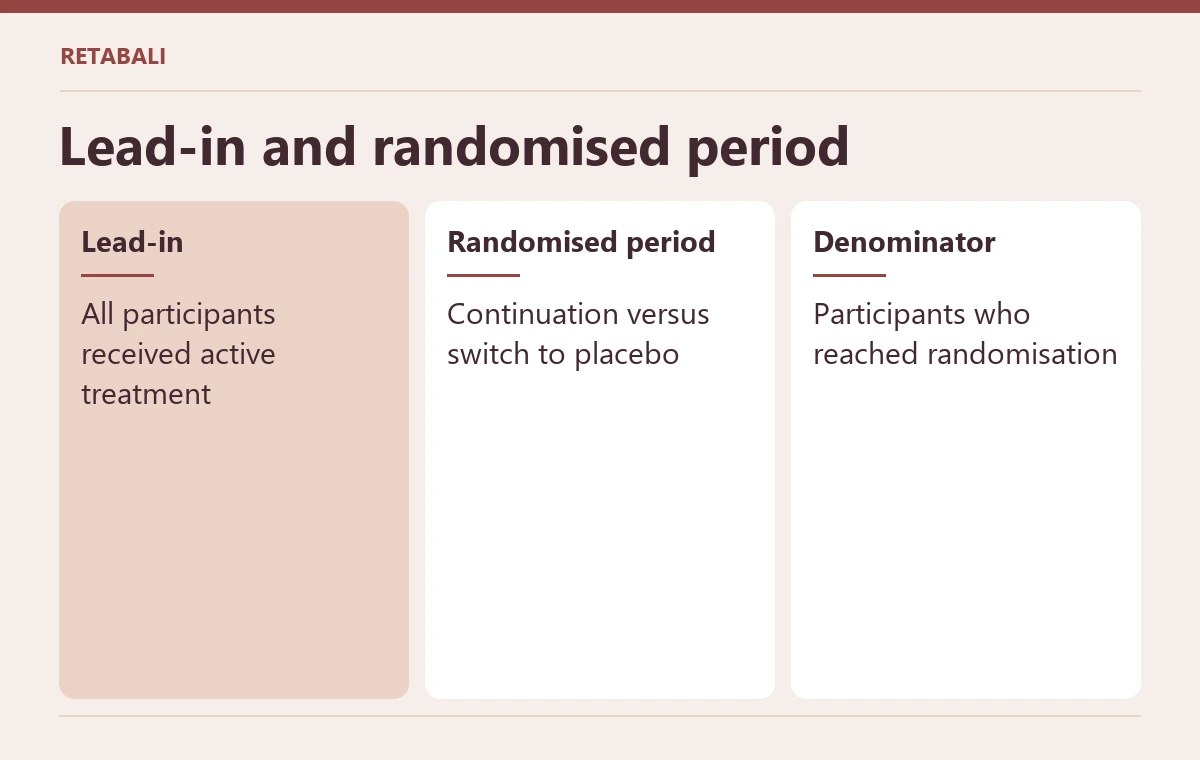
A randomised withdrawal trial answers a question about people who reach the withdrawal stage. It is a different group from everyone offered treatment for the first time.
Read the randomisation line twice
In SURMOUNT-4, participants had an open-label tirzepatide lead-in. Those who reached randomisation then continued treatment or switched to placebo. The group comparison after that visit has the later time point as its baseline. Continued Treatment With Tirzepatide for Maintenance of Weight Reduction in Adults With Obesity: The SURMOUNT-4 Randomized Clinical Trial
In a withdrawal design, all participants may receive an intervention before a later randomised comparison begins. The people represented in the later groups have navigated that earlier period. An initial referral, entry into the lead-in and assignment to continue or withdraw are different points. A headline may describe what happened after withdrawal without reminding the reader who reached it. Finding the participant flow diagram usually resolves which group and time period the published percentage represents.
A useful personal question may fall outside the design
A Bali reader sees mean regain in the withdrawal group and assumes it describes a percentage of the original starting weight for every person. Check the definition of percentage change and the number of participants entering each stage before drawing that conclusion.
Someone deciding whether to begin prescribed treatment may care about the chance of early intolerance or the likelihood of continuing through the first period. Someone already doing well may care about maintaining change under continued treatment versus withdrawal. These questions are related but are not answered by the same denominator. Label the outcome by the visit used as its starting reference and whether the comparison group received active treatment or placebo. That short annotation is often more valuable than printing an extra decimal place on a summary.
What belongs in a personal discussion?
A second practical check concerns who left the study before randomisation. Reasons could differ, and someone reaching that visit has necessarily remained in the earlier phase long enough to be eligible. This selection is part of the design, not an error in arithmetic. It does, however, narrow what a randomised withdrawal result addresses. If the question concerns how often people who start treatment continue through the initial period, that requires the earlier flow diagram. If the question concerns maintenance among people reaching randomisation, the later comparison is the more relevant one.
Some readers want the trajectory during the initial lead-in and others the comparison after withdrawal. Use the correct graph for each rather than treating the last point on one as a baseline common to both.
Keep separate the question of beginning treatment and the question of maintaining an earlier change. Decisions about continuing or stopping prescribed medicine belong with the prescriber and an individual follow-up plan.
