Randomised and blinded mean different things in a retatrutide paper
Randomisation concerns assignment to study groups.
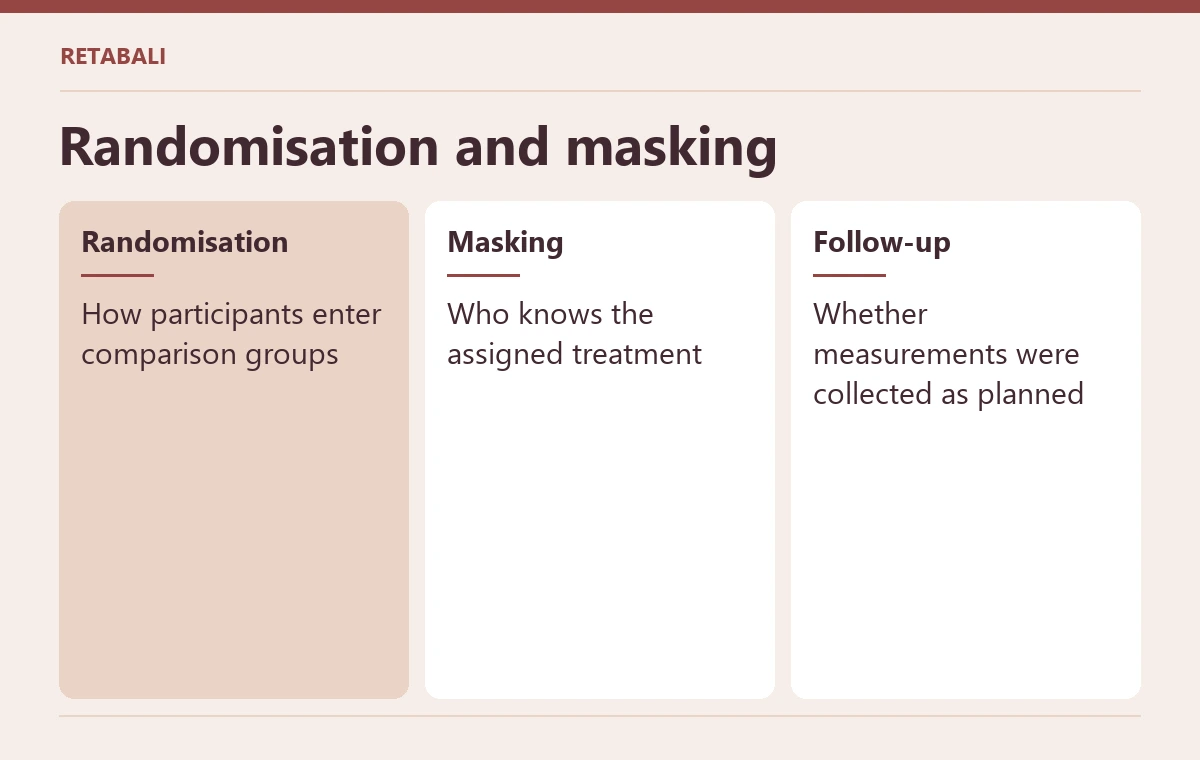
Randomisation concerns assignment to study groups. Blinding concerns who knows the assignment. The words can appear together in a retatrutide trial, but each addresses a separate source of uncertainty.
Who chose the group?
The phase-two obesity study used random assignment and blinding to compare retatrutide groups with placebo. The registry glossary distinguishes allocation from masking. Neither term guarantees that every participant completed all follow-up visits. Retatrutide phase-two obesity trial ClinicalTrials.gov study record glossary
Random assignment is a procedure carried out before the treatment comparison. Its purpose is to avoid letting participants' preferences or a clinician's selection of apparently suitable people determine the groups. It does not guarantee equal values for every baseline characteristic in any one sample. Look at the enrolment criteria and baseline table to see who was included. Two groups may be comparable within the study while still differing from a population outside the study. A trial conducted in eligible adults is not made universally representative by random assignment.
Who knew the assignment?
Imagine a comparison in Bali where people choose their own group but the person measuring their weight does not know their choice. The measurement is masked, yet the groups may differ because people selected themselves. Reverse the scenario and a trial can be randomised but open-label.
Masking changes the information available during follow-up. Knowing which treatment was given could affect expectations, reporting or assessment for some endpoints. For a particular figure, ask whether the outcome was a participant report, a laboratory value or an event assessed according to stated rules. Masking addresses certain potential biases; incomplete follow-up, measurement error and applicability to a different population require their own checks. When a headline says a trial was double-blind, the methods are still needed to identify the treatment, comparator and actual endpoint.
Keep the comparison with the figure
Masking can also differ by role. Participants, those administering interventions, investigators and outcome assessors need not all have the same information. The paper's description should say whom the masking covered. A broad label such as blinded is a starting point for reading the methods, not a substitute for checking those roles.
An outcome can also be assessed more than once. Knowing the assignment could matter differently for a self-reported symptom and for a machine-generated laboratory value. Read how the authors collected and checked the particular endpoint, rather than assigning a single certainty rating to everything in the paper.
When reading a methods paragraph identify who assigned treatment, who was masked and what endpoint was measured. Missing data and study duration remain separate considerations after both design features are established.
