What a washout period does in an NAD precursor crossover trial
In a crossover trial the same participant receives the study interventions in different periods.
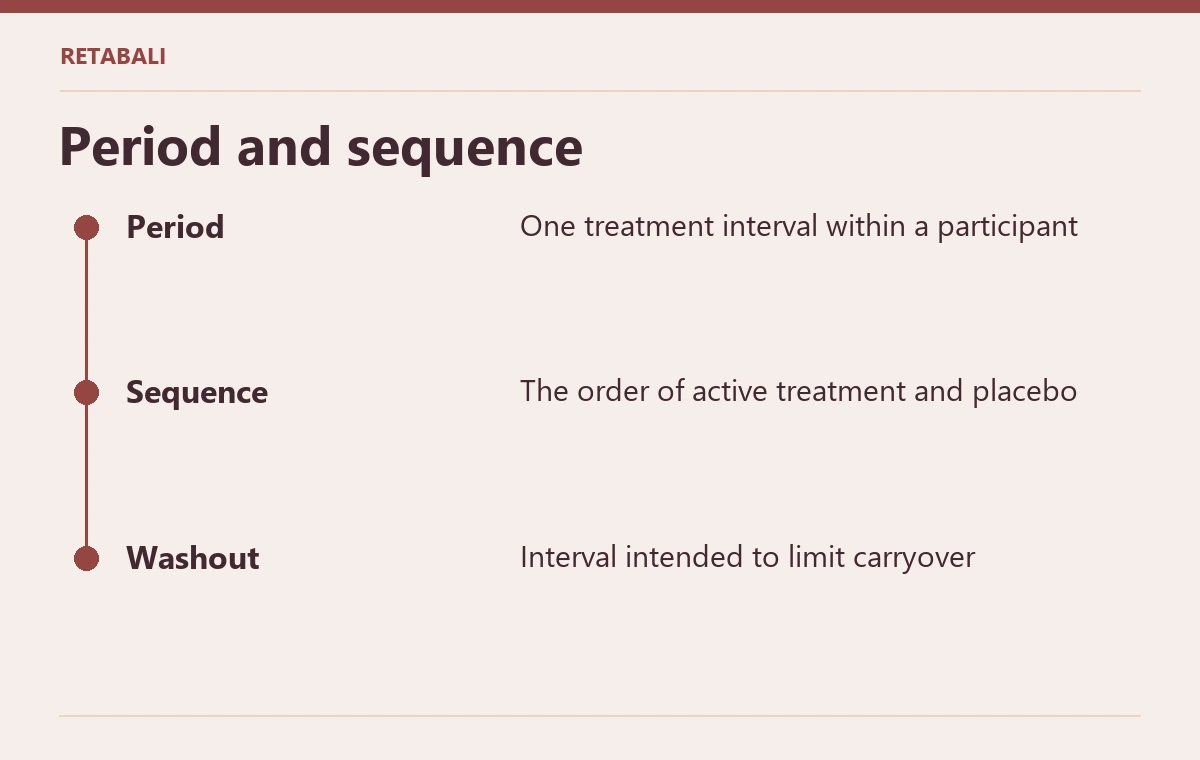
In a crossover trial the same participant receives the study interventions in different periods. A washout is intended to reduce effects carried over from the preceding period. It does not turn the study into a comparison of different product routes.
Compare periods within the same participant
The nicotinamide riboside trial in healthy middle-aged and older adults used a randomised, double-blind, placebo-controlled crossover design. It investigated an oral precursor and biochemical outcomes under its defined schedule. Chronic nicotinamide riboside supplementation is well-tolerated and elevates NAD<sup>+</sup> in healthy middle-aged and older adults
The attraction of a crossover design is that a participant can supply information under both conditions. Stable differences between people therefore have less opportunity to explain the comparison. The price is that what happens in one period may affect another, and the passage of time may matter independently of the treatment. A design can randomise the sequence and incorporate a washout to limit these influences. An actual analysis still depends on the assumptions and data described in its methods.
The design does not change the intervention
Suppose a participant's baseline differs between the first and second period. The methods should explain how period and sequence are handled, and whether lingering effects could influence the estimate. Plotting results in calendar order without labels obscures this structure.
An oral precursor is metabolised through a set of biological processes investigated in the study. A different compound or route sold under an NAD-related description is not one of the treatments assigned to those participants. Even a clear within-person biochemical difference would therefore concern that particular comparison. It also would not establish that a symptom improved unless the symptom was measured and analysed. Read the study's intervention, the specimen and the outcome as separate facts. Changing one while retaining the word crossover gives the reader a different claim from the one the research tested.
Where the evidence ends
Place the treatment, specimen and observation period beside the carryover question. A crossover design cannot establish that a different compound or route would have the same duration of effect.
A washout period is a design decision intended to reduce carryover. Its presence does not prove carryover was impossible. To assess whether it remained a concern, read the rationale for the interval and the analysis of period or sequence where available. If those details are missing, note the uncertainty instead of assuming a negative result.
A Bali reader considering an NAD+ claim can first establish the substance, route and design. A comparison within the same people may reduce between-person differences, but it cannot establish outcomes that the study never measured.
