Diabetes prevention with tirzepatide: which participants were followed?
The longer diabetes-prevention analysis concerned participants with obesity and prediabetes.
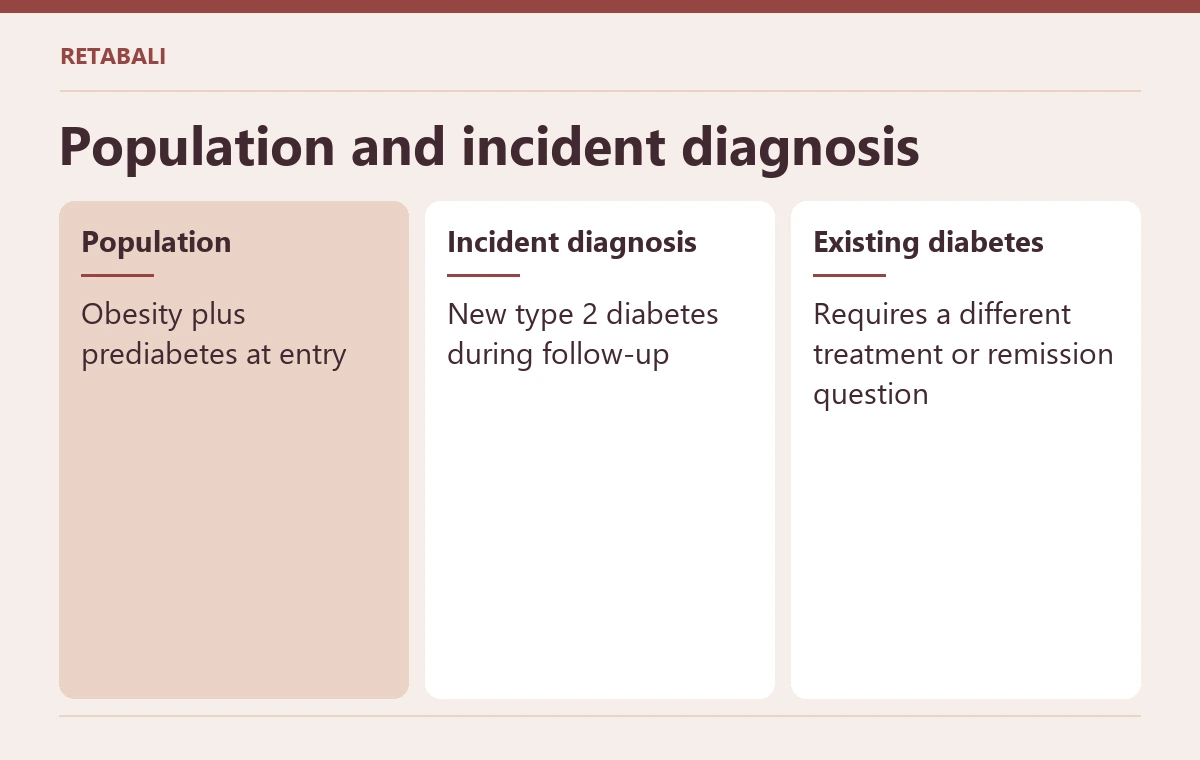
The longer diabetes-prevention analysis concerned participants with obesity and prediabetes. Its incidence of type 2 diabetes over follow-up is not the percentage decrease in an existing HbA1c value.
Keep the starting diagnosis visible
The extended SURMOUNT-1 research evaluated weight and progression to type 2 diabetes in a defined subgroup. On-treatment observations and a subsequent off-treatment period have different time origins and answer different questions. Tirzepatide for Obesity Treatment and Diabetes Prevention
Prediabetes describes a starting group that may develop type 2 diabetes during follow-up. An incident diagnosis is counted when the study's criteria are met in someone without the condition at baseline. A lower incidence across the observation period and a decrease in a person's existing HbA1c are mathematically different results. Even when they appear in the same paper, one involves the onset of a defined condition and the other involves change on a continuous measurement scale.
What changes after active treatment ends?
A Bali reader with established type 2 diabetes asks whether the prevention figure means their diabetes will disappear. An endpoint for new diagnoses among people who did not have diabetes at enrolment cannot answer a remission question among those who already do.
A follow-up visit after assigned treatment ends provides information about that later interval. An on-treatment estimate describes a different period. If one reads a figure without noting when the study treatment stopped, later observations can be misrepresented as effects measured entirely during active treatment. Check the methods and figure legend rather than assuming every date on the horizontal axis represents time receiving the same intervention.
What belongs in a personal discussion?
There is a difference between a diagnosis present at the beginning and an event that occurs during observation. For the prevention question, a person must start at risk of developing the specified condition and be followed long enough to assess it. Someone already living with that condition would need an endpoint concerning management or remission instead. Documentation of a weight change is useful but does not in itself resolve a diagnostic endpoint. Check whether the study defined it through laboratory criteria and confirmation procedures. If a follow-up interval extended beyond the end of assigned treatment, place that interval on a separate line rather than adding it to the exposure period in a headline.
A clinical endpoint about a new diagnosis also has an observation window. A person without a recorded diagnosis by the final visit has been observed for the period covered, not for the rest of their life.
Before carrying a number into an appointment, write down baseline diabetes status, how a new diagnosis was defined and the observation period. The interpretation changes if any of those elements changes.
