Three receptor signals are not three equal clinical effects
Retatrutide is one molecule studied for activity at GIP, GLP-1 and glucagon receptors.
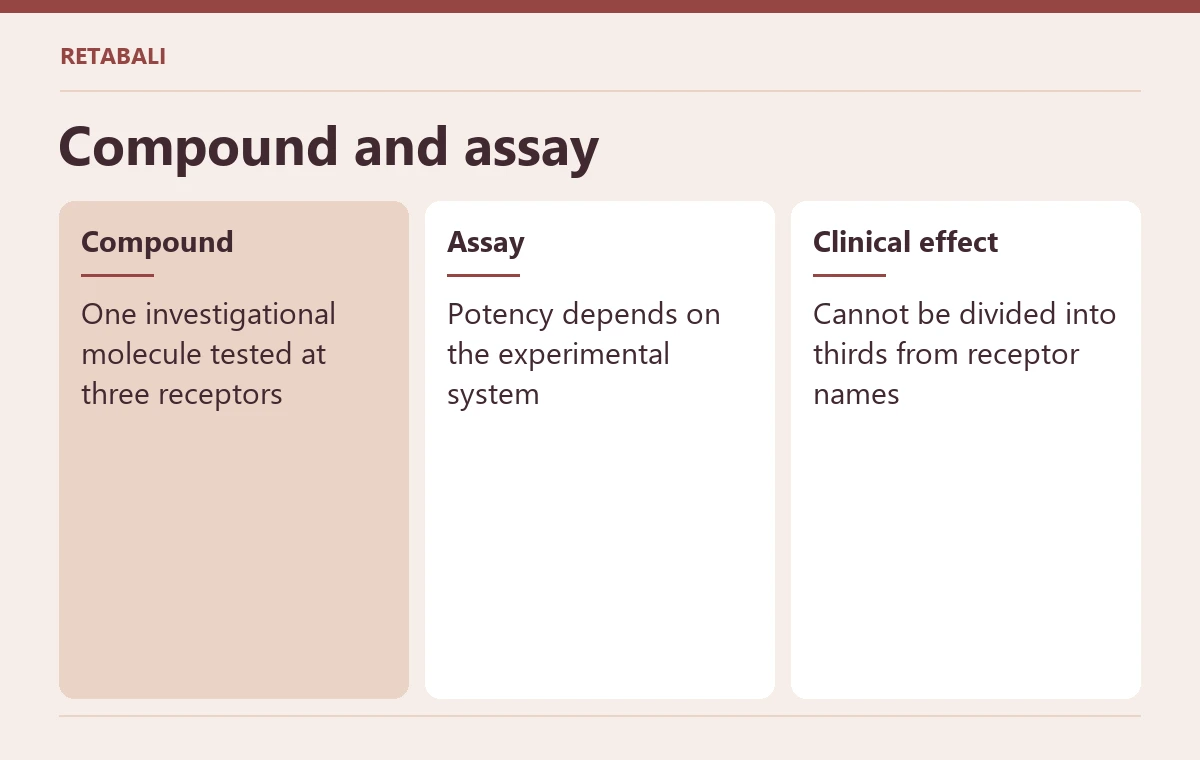
Retatrutide is one molecule studied for activity at GIP, GLP-1 and glucagon receptors. Listing three receptors says nothing about an equal division of a clinical effect among them.
What was held constant in the assay?
The early LY3437943 research describes receptor pharmacology and preclinical and early human investigation. Laboratory activity depends on the assay, comparison ligand and measurement used. A potency figure from a receptor assay is not a fraction of someone's eventual weight change. LY3437943, a novel triple glucagon, GIP, and GLP-1 receptor agonist for glycemic control and weight loss: From discovery to clinical proof of concept
An experimental system can isolate the response of one receptor while controlling features of the system and comparing responses with a reference. That answers a well-defined laboratory question. In a living person, tissues differ, the concentration available at a site changes over time and biological pathways interact. A result expressed relative to another ligand in an assay is not a measurement of how much each pathway contributed to a person's change in weight. The mathematical language of relative potency should therefore stay attached to the assay that produced it.
Choose a claim the study could test
A Bali reader imagines that each receptor explains one third of the result on a scale. To test that proposition researchers would need a design separating the contributions in a living system. Showing activity in three separate assays does not provide that decomposition.
Consider the difference between saying a molecule activated each of three tested receptors and saying it produced equal benefits through those receptors in people. The first claim can be investigated by receptor assays using suitable controls. The second would require a design that identifies separate contributions to a defined human endpoint. A clinical weight result, by itself, still measures the overall outcome under the treatment tested. It does not decompose that outcome into independent thirds. This matters when a comparison graphic places three identically sized icons beside a product; equal visual space is a design choice, not a quantitative pharmacology result.
Keep the comparison with the figure
A result can be valuable for choosing a molecule to study without providing a clinical prediction. For example, researchers may compare how a molecule behaves in separate receptor systems before choosing a subsequent human study. The evidence is strongest for the exact measurement that was made in each system.
Retaining the reference ligand and assay name next to any figure is a simple safeguard when several experiments appear in one paper. Their axes may share a percentage sign while their underlying comparisons differ.
Read receptor names, assay endpoints and clinical outcomes on separate lines. A receptor finding can explain why a question is scientifically interesting without supplying a personal efficacy prediction.
