Long-Term Tirzepatide Results: What Maintenance Adds
Explore the long-term tirzepatide findings from SURMOUNT-4, why maintenance was measured and how to compare a defined pen format for your Bali enquiry.
Long-term tirzepatide research asks a valuable question: what happens after the initial weight reduction? In SURMOUNT-4, continued treatment maintained and extended the reduction achieved during an initial study period. The result adds a longer-term perspective to a conversation that often focuses only on the first visible change.
For readers exploring long-term tirzepatide results in Bali, Indonesia, it helps to separate the initial treatment period, the maintenance comparison and the product format offered locally. Our catalogue presents 30 mg and 60 mg pre-filled pens, while the clinical evidence describes the specific medicines and conditions used in the trial.
Why the maintenance question matters
A short study can show what happens during an initial period. A maintenance study asks whether the change can be sustained and what happens under different follow-up conditions. That is a different question from simply measuring how quickly the scale first moves.
The distinction is useful for anyone thinking beyond a holiday or a short wellness stay. A long-term goal needs an ongoing clinical plan, while local purchasing logistics need a clear product identity and receiving arrangement. The two should support one another rather than become separate conversations.
How SURMOUNT-4 was structured
In SURMOUNT-4, participants first completed a 36-week open-label tirzepatide period. A total of 670 participants were then randomised to continue tirzepatide or switch to placebo for another 52 weeks. The study excluded diabetes and involved adults meeting its obesity or overweight-related criteria.
The initial period produced a mean weight reduction of 20.9% in the participants who reached randomisation. The later comparison therefore examined what happened after a substantial initial response, not a fresh group starting from the same point without prior treatment.
That design detail is essential to the meaning of the result. It also explains why figures from the maintenance period should not be presented as if they described the first weeks of use.
The longer-term findings
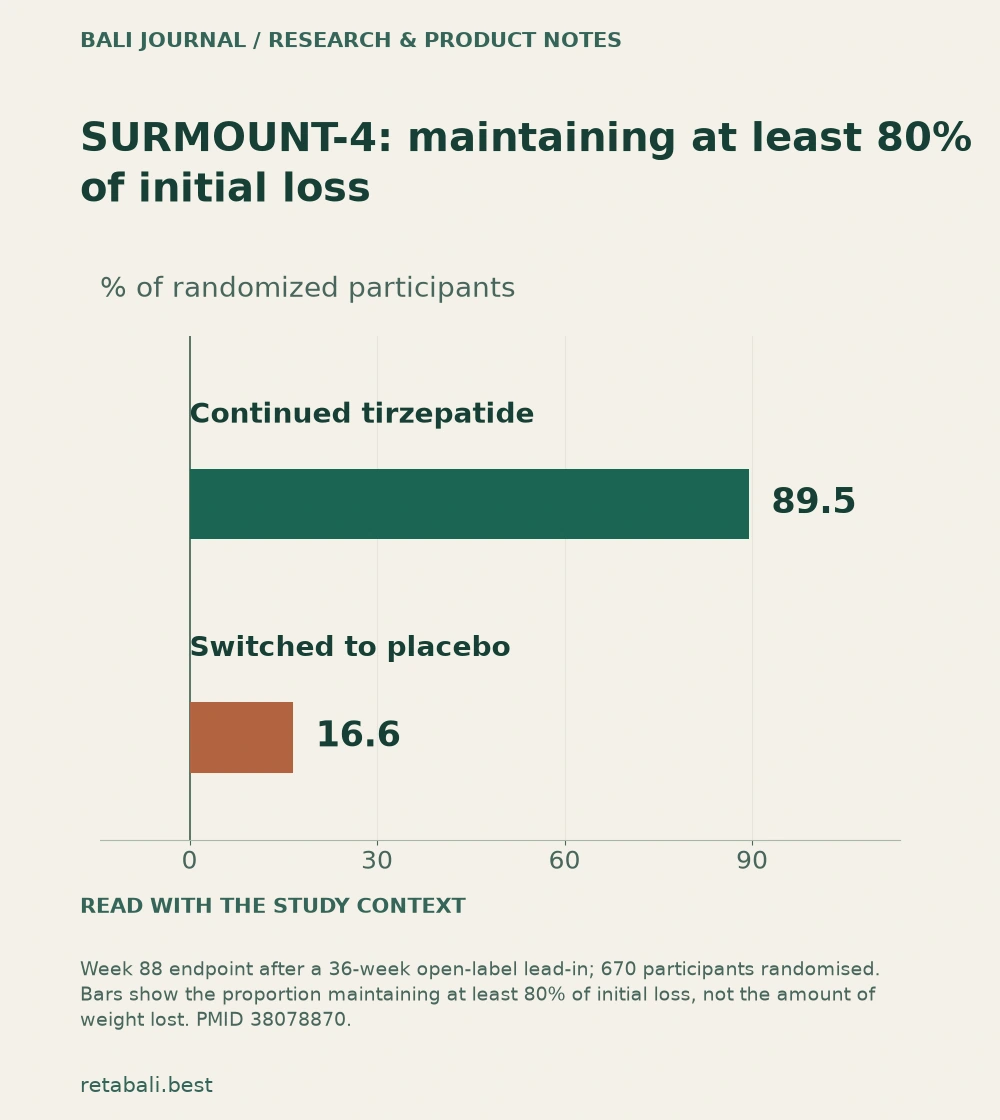
From baseline to week 88, the overall mean weight reduction was 25.3% with continued tirzepatide and 9.9% in the withdrawal group. A separate endpoint assessed how many participants maintained at least 80% of the loss achieved during the initial period: 89.5% with continued tirzepatide versus 16.6% after switching to placebo.
| Study period or endpoint | What it tells you |
|---|---|
| Initial 36-week period | The response before randomisation |
| Weeks 36 to 88 | The maintenance comparison after that initial response |
| Baseline to week 88 | The overall change across the full study sequence |
| At least 80% of initial loss maintained | A defined measure of durability, rather than a new target weight |
The study's strongest message is the measured value of continued treatment within its design. It is not an instruction to stop, restart or change an individual regimen. Those decisions need the clinician who knows the person's history and current treatment.
A useful way to read long-term results
Start by identifying the baseline for each number. A change measured from the start of a study and a change measured from the beginning of a maintenance phase are different calculations. Keeping the starting point visible prevents two legitimate figures from being compared as though they were contradictory.
Next, check who reached the later study stage. In this trial, participants had already completed an initial treatment period before randomisation. That context matters when you relate the research to someone who is only beginning to explore the compound.
Finally, keep benefits and tolerability in the same evidence picture. The trial reported gastrointestinal adverse events, generally mild to moderate, more commonly with tirzepatide than placebo. A longer-term discussion should retain those observations alongside the weight findings.
Bringing the long-term perspective to a Bali stay
A Bali stay can involve new accommodation, a different time zone and a busy travel schedule. The practical goal is to keep product information and an existing clinical plan easy to communicate. Write down the exact compound and presentation you are discussing, rather than relying only on a brand nickname or an image saved on your phone.
If you are enquiring about a local product, ask which presentation is supplied and review its own information. A study result does not establish equivalence between every product carrying the same ingredient name, which is why the actual pack belongs in the conversation.
For Seminyak, Canggu or Uluwatu receiving arrangements, include the accommodation name, map pin where helpful and a time when someone will be available. If you are moving between locations, specify which address applies to the order enquiry.
Compare the offered tirzepatide pen formats
Our tirzepatide product listing shows the available 30 mg and 60 mg pens and catalogue prices. These amounts describe total labelled contents, helping you compare the complete presentations before contacting the team.
Availability and delivery arrangements are confirmed for the actual enquiry. Keep the selected presentation, quantity and local receiving details together so that the conversation stays specific from product selection to confirmation.
Tirzepatide's longer-term evidence adds something important to its benefit story: measured maintenance after a substantial initial reduction. Use that evidence to ask better clinical questions, then use a precise product listing to make the Bali purchasing conversation clear and organised.
