NAD+ vs NADH: The Cellular Energy Cycle Explained
Understand NAD+ and NADH, electron transfer and why a Bali NAD+ pen differs from an IV service or an oral precursor supplement.
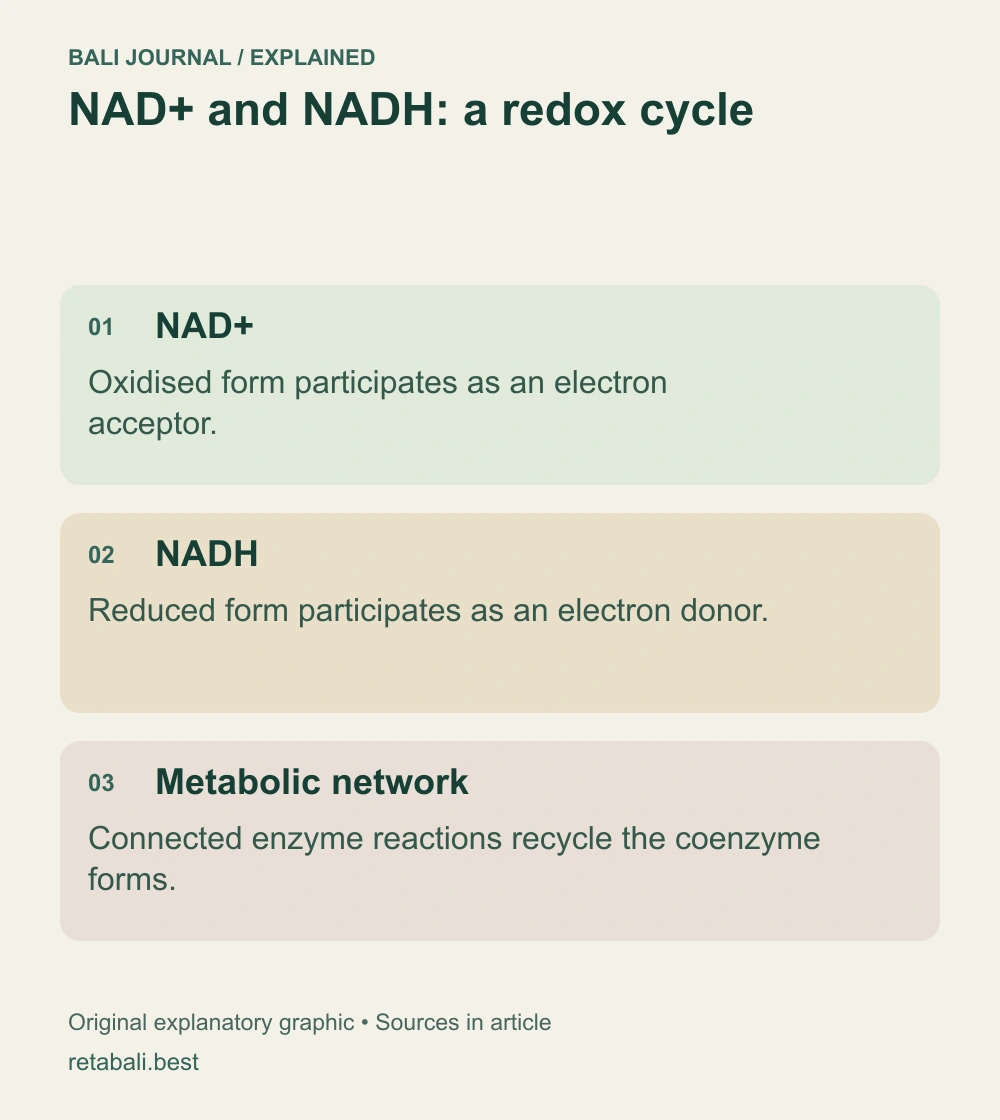
The quickest way to understand NAD+ and NADH is to see them as two forms of a coenzyme involved in electron transfer. NAD+ is the oxidised form; NADH is the reduced form. Their relationship is part of how cells process nutrients and transfer energy through metabolic reactions.
That is a substantial biological role, and it explains why NAD+ attracts attention in Bali's wellness conversation. It also gives you a better starting point for comparing products than a general claim about feeling “recharged.” First understand the molecule, then look at the exact format, contents and price.
What redox means without the jargon
Redox combines reduction and oxidation. In simple terms, these reactions involve the transfer of electrons. NAD+ can accept electrons as it becomes NADH; NADH can participate in reactions that return it to the oxidised form.
The cycle matters because metabolism depends on connected reactions rather than a single isolated ingredient. Food-derived molecules are processed through pathways whose components have to work together. NAD/NADH is one part of that organised system.
A diagram of this cycle is therefore a map of biochemical roles, not a battery-level indicator for a person. It explains why the coenzyme is important without assigning a numerical energy boost to a product.
A molecule with more than one job
A primary biochemical study of NAD and related analogues illustrates the distinction between redox coenzyme activity and use as a substrate for other enzymes. NAD's roles include relationships with PARPs and sirtuins as well as electron-transfer reactions.
These are different biochemical tasks. A useful NAD+ article should explain which task is being discussed rather than treating “energy,” “repair” and “longevity” as three interchangeable descriptions of the same measured benefit.
The chemical identity also matters. NAD+ is not a peptide, and it is not the same substance as nicotinamide riboside or nicotinamide mononucleotide. Those compounds are discussed as precursors in NAD synthesis pathways. A shared place in the wider NAD conversation does not make their supplied amounts or routes equivalent.
Blood measurements are not a whole-body energy score
A human pilot study followed plasma and urine metabolites during a six-hour intravenous NAD+ infusion. The researchers examined the fate of the administered molecule and related metabolites over time. That provides pharmacological information about the investigated IV setting.
The study did not compare a commercial pen with oral precursors, nor did it establish a particular improvement in athletic performance or everyday fatigue. A change in the concentration of a molecule answers a concentration question; a clinical benefit requires an appropriate clinical measurement.
This distinction helps you read product pages more confidently. If a seller cites an IV experiment, check whether the product is actually an IV service or a different presentation. The same ingredient name does not erase the importance of route and formulation.
NAD+ pen, IV service and precursor supplement
These three options differ in what you are comparing. A pen is a packaged product. An IV service combines a preparation with administration and a provider's setting. An oral precursor supplement supplies a different named molecule that enters NAD-related metabolic pathways.
| Comparison | What needs to be identified |
|---|---|
| NAD+ pen | Ingredient, total pack contents, supplied information and price |
| NAD+ IV service | Preparation, route, provider and service details |
| NR or NMN supplement | Exact precursor, quantity and oral product information |
That framework is more useful than comparing a number of milligrams across all three as though they represented the same intervention. The substance, presentation and evidence should all match the question you want answered.
The Bali catalogue presentation
The NAD+ product page lists a 1000 mg prefilled pen for IDR 3,000,000. The amount describes total labelled contents. It makes the catalogue item easier to compare, but it is not a personal administration schedule or a direct measure of intracellular NAD availability.
Open the product photographs alongside the listing. Match the name and amount, review the supplied guide and ask for the information relevant to the particular pack. A transparent product enquiry should stay connected to the item actually offered.
The advantage of a defined catalogue presentation is clarity: a named molecule, a visible format and an item price in Indonesian rupiah. It gives the commercial conversation a concrete reference instead of relying on a generic “NAD treatment” label.
A practical next step in Bali
For an enquiry from Seminyak, Canggu, Ubud or Uluwatu, send the NAD+ 1000 mg presentation, quantity and receiving address. Include the accommodation name and a map pin if the entrance is not obvious. Availability and the actual receiving arrangements are confirmed for that enquiry.
NAD/NADH cycling is an elegant part of cellular metabolism, and understanding it makes the wider NAD+ conversation more meaningful. Use the science to recognise the molecule's role, then use the current Bali product listing to compare the specific presentation in front of you.
