Who qualified for randomisation after the SURMOUNT-3 lifestyle phase?
SURMOUNT-3 started by asking participants to complete an intensive lifestyle intervention.
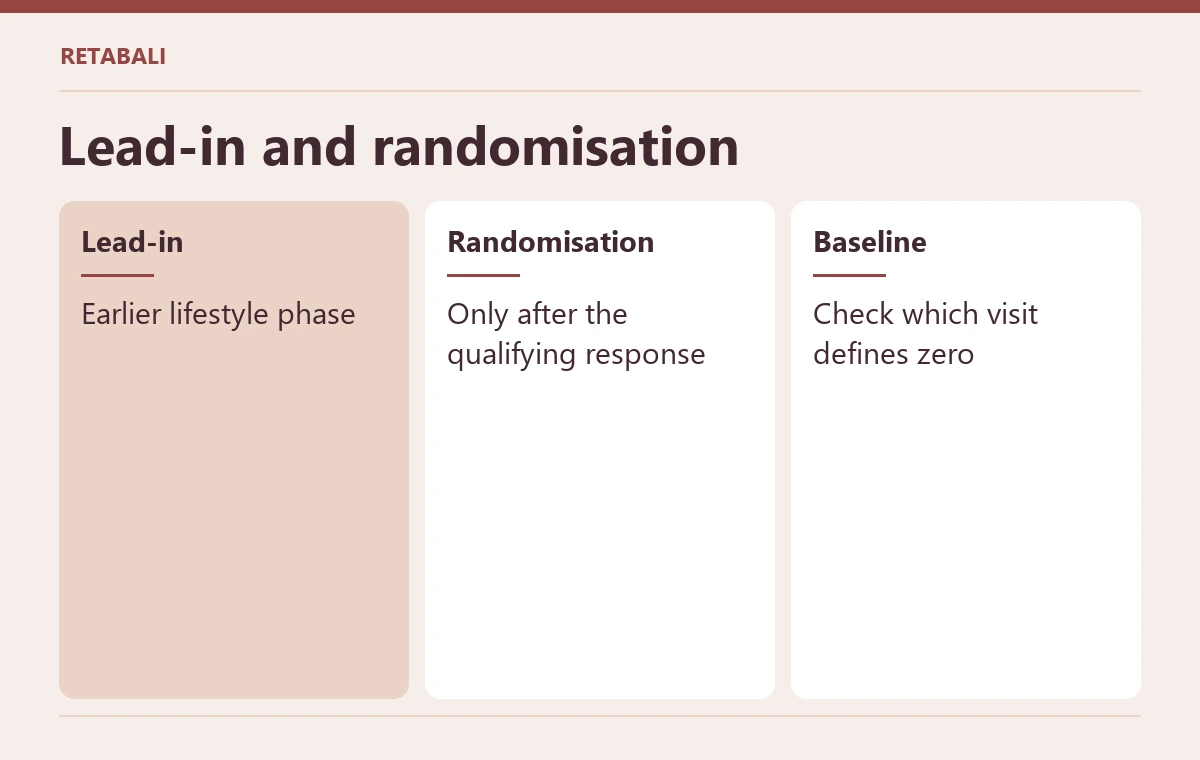
SURMOUNT-3 started by asking participants to complete an intensive lifestyle intervention. The randomised treatment comparison therefore describes people who passed a defined entry step, not everyone who first expressed interest in the study.
Who passed through both stages?
The trial randomised eligible participants who achieved the required weight reduction during the initial intervention. The reported change after randomisation starts from that later visit. Changes during the lead-in are distinct from the subsequent placebo-controlled comparison. Tirzepatide after intensive lifestyle intervention in adults with overweight or obesity: the SURMOUNT-3 phase 3 trial
Participant flow can be drawn as a sequence. Some individuals entered the initial intervention, a subset met the qualifying conditions and reached randomisation, and participants then supplied differing amounts of follow-up data. Counts at these stages need not match. Read the initial programme and randomised comparison as two related parts of a design. A person who did not reach randomisation contributes information about entering the programme but was not assigned to either treatment in the later comparison.
Percentage change depends on the starting value
Imagine two graphs both beginning at zero. One starts on arrival at the lifestyle programme and the other at randomisation. They assign different calendar dates and starting weights to zero. Adding two percentage changes with different baselines directly gives the wrong arithmetic.
For simple arithmetic, imagine a quantity falling from one hundred units to ninety, then from ninety to eighty-one. The first fall is ten percent of the original, the second ten percent of the later value, while the total decrease is nineteen percent of the original. This example illustrates sequential denominators rather than the trial's actual weight estimates. It shows why two percentages from different phases cannot simply be added. When a patient wants to know what happened after randomisation, use the value and follow-up attached to that specific period.
Keep the comparison with the figure
For example, the change between the original programme start and the last study visit includes two periods, each with its own conditions. A rate calculated after randomisation is a measurement of what happened during the later comparison. Preserving both dates lets a reader distinguish a result achieved before assignment from a difference that emerged under the randomised comparison.
The comparison group is important during interpretation of the later phase. Both groups entered it after the earlier qualifying process, so their contrast is designed to address what happened after assignment. It cannot determine the independent contribution of every element in the earlier programme.
A reader in Bali comparing a headline with personal experience should look for the qualifying criterion, number entering the initial phase and number actually randomised. Record which period the published outcome covers.
