Blood NAD and a muscle biopsy answer different questions
Where the sample came from matters when interpreting studies of a precursor to NAD.
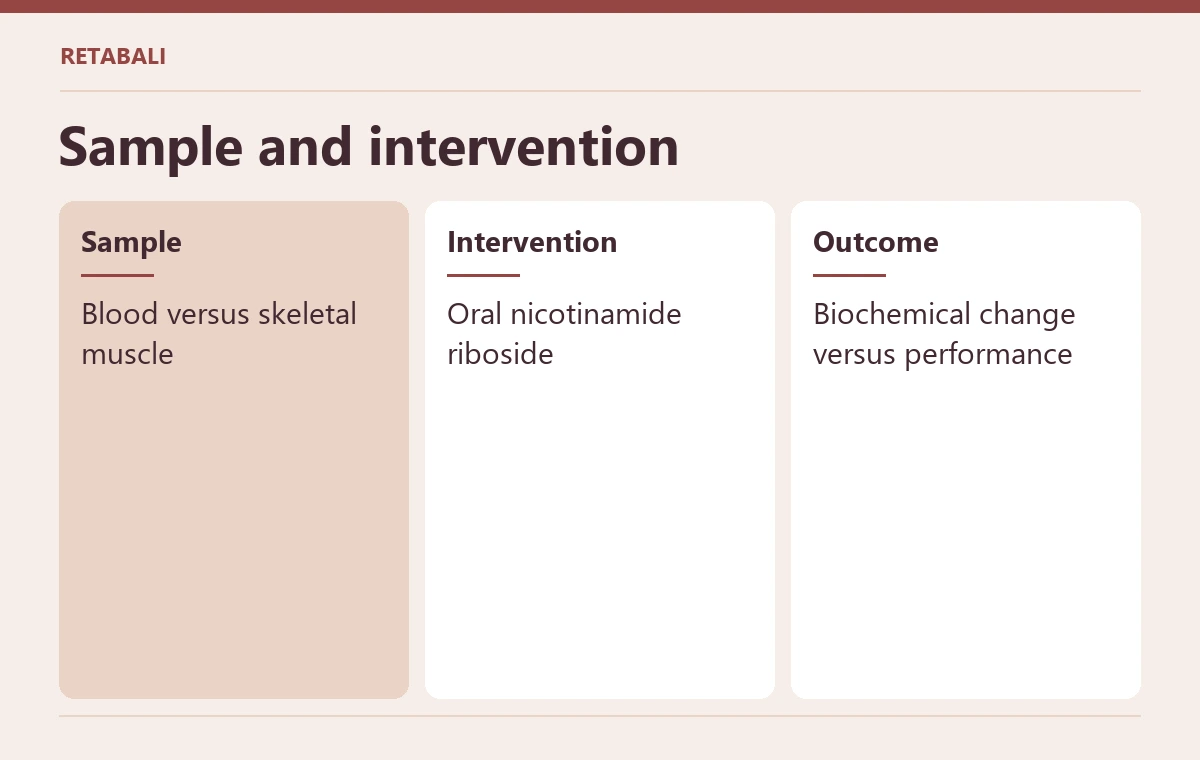
Where the sample came from matters when interpreting studies of a precursor to NAD. A whole-blood result cannot simply be read as a muscle measurement, and neither one automatically measures exercise performance.
What a tissue sample can stand for
Two primary human studies of nicotinamide riboside illustrate the distinction. One investigated supplementation in healthy middle-aged and older adults; another examined the NAD-related metabolome in skeletal muscle of older men. The test material was an oral precursor, not a retail NAD+ pen. Nicotinamide Riboside Augments the Aged Human Skeletal Muscle NAD<sup>+</sup> Metabolome and Induces Transcriptomic and Anti-inflammatory Signatures Chronic nicotinamide riboside supplementation is well-tolerated and elevates NAD<sup>+</sup> in healthy middle-aged and older adults
A blood specimen is accessible and can be collected repeatedly under a defined protocol. A biopsy provides information about the sampled tissue at the chosen times. These advantages are different. Seeing a change in whole blood does not tell the reader exactly which changes occurred in skeletal muscle, and a small piece of sampled muscle does not represent every organ. Keep the specimen in the sentence whenever describing an effect on an NAD-related marker.
When two primary papers sit side by side
A Bali reader puts a blood graph from one paper next to a skeletal-muscle graph from the other. Differences could reflect the sample, population, study design or analytical endpoint. They do not form a direct comparison between the two study interventions.
A literature search can return two studies that both mention the same oral precursor without forming one matched experiment. Participants may differ in age, sex, starting health, protocol and collection methods. Those differences make the studies informative for separate questions while confounding a simplistic numerical comparison. A reader interested in performance should additionally identify which task, symptom scale or clinical outcome was assessed. If a paper primarily reports laboratory results, quote those results in the context of the specimen rather than filling in the missing performance measurement with a personal impression.
What belongs in a personal discussion?
One helpful way to annotate a figure is to write “sample collected from” above the vertical axis and “substance given to participants” beside the methods. If the first label says muscle and the second says nicotinamide riboside, changing either word when sharing the finding changes the question. A biochemical outcome can be valuable on its own terms without acquiring an unmeasured promise of energy or strength.
One specimen could also contain a collection of related metabolites rather than a measure of NAD alone. Record which analyte the graph quantified before interpreting terms such as higher NAD metabolism.
For each figure, copy the sample type, compound actually given and clinical outcome if there was one. Look for a direct human comparison before drawing conclusions about energy or route of administration.
