Can retatrutide stand in for emergency glucagon in Bali?
Why a retatrutide pen cannot replace prescribed rescue glucagon during a severe low, and what a travel companion in Bali needs to know before an emergency.
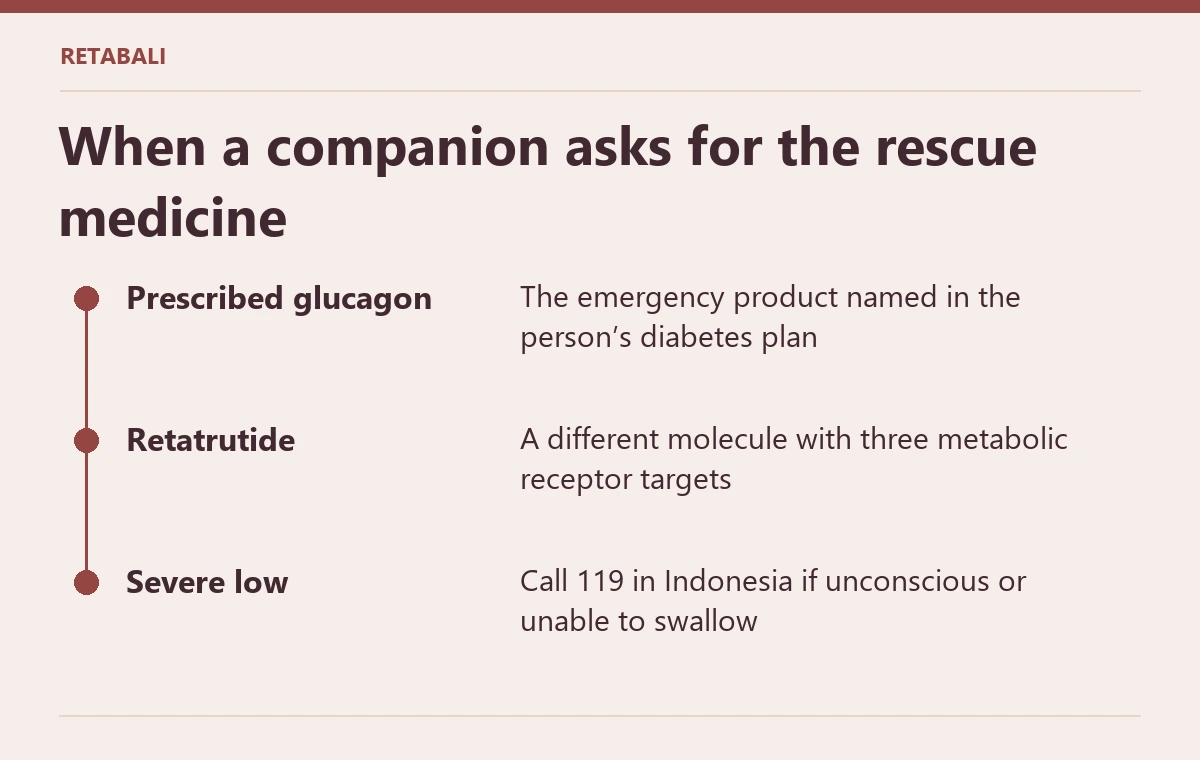
If someone with diabetes has lost consciousness or cannot swallow safely during a suspected low, call Indonesia’s medical emergency service on 119. Give nothing by mouth. If the person has prescribed rescue glucagon and you have been taught how to use that product, follow their emergency plan while arranging urgent help. Never give retatrutide for a low. Its name appears alongside the word “glucagon” in research for a different reason. Indonesia’s medical emergency service and CDC guidance on severe low blood sugar.
What the retatrutide paper actually tested
Someone packing medicines for a Bali trip might find a description of retatrutide as a “glucagon receptor agonist” and wonder whether it could cover two jobs. The word receptor identifies one of the biological targets that this molecule can activate. Retatrutide was designed to act at three receptors involved in metabolism, those for glucagon, GIP and GLP-1. The development paper looked at how the molecule behaved in experimental systems and at its metabolic effects in early clinical work. It did not test giving it to an unconscious person to restore blood glucose. Coskun and colleagues’ original development study.
That distinction matters most when two products happen to look alike. A relative who hears “use the pen” has to pick a specific prescribed rescue device quickly. The ingredient, intended use and instructions on its package identify the right one. The shape of a device or a word in a research abstract cannot do that job.
How investigators tested a genuine rescue product
Rickels and colleagues brought adults with type 1 diabetes into a monitored setting. They used insulin to lower participants’ glucose and compared two preparations of glucagon, one nasal and one intramuscular. The same participants attended different sessions, which let the researchers compare responses within a person. They measured how quickly glucose rose after treatment during a documented low. That immediate response was the outcome the experiment was designed to establish. Neither preparation contained retatrutide. Randomised crossover trial of rescue glucagon.
A monitored research visit has staff, measurements and a known cause for the low. In a villa or hotel, a companion may have none of those advantages. The study explains the purpose of a rescue medicine. It does not provide a reason to postpone a call for emergency help or improvise a substitute.
What to tell the person travelling with you
Before an outing, show a companion the exact rescue package your diabetes team prescribed, where you keep it and where to find its instructions. Check the expiry date together. If several family members carry pens, identify whose rescue product it is. Keep your clinician’s written plan with it and ask the clinician to explain anything unclear before travel. A photograph of the correctly labelled box can help with identification across languages.
For a stay in Bali, give that companion the accommodation’s street address, a nearby landmark and the entrance a medical team can reach. In an emergency these details are more useful than the name of a booking alone. A retailer’s contact form cannot dispatch medical emergency help.
