Endogenous MOTS-c on a lab graph and a labelled product
Detecting a peptide produced by the body establishes its presence under the measured conditions.
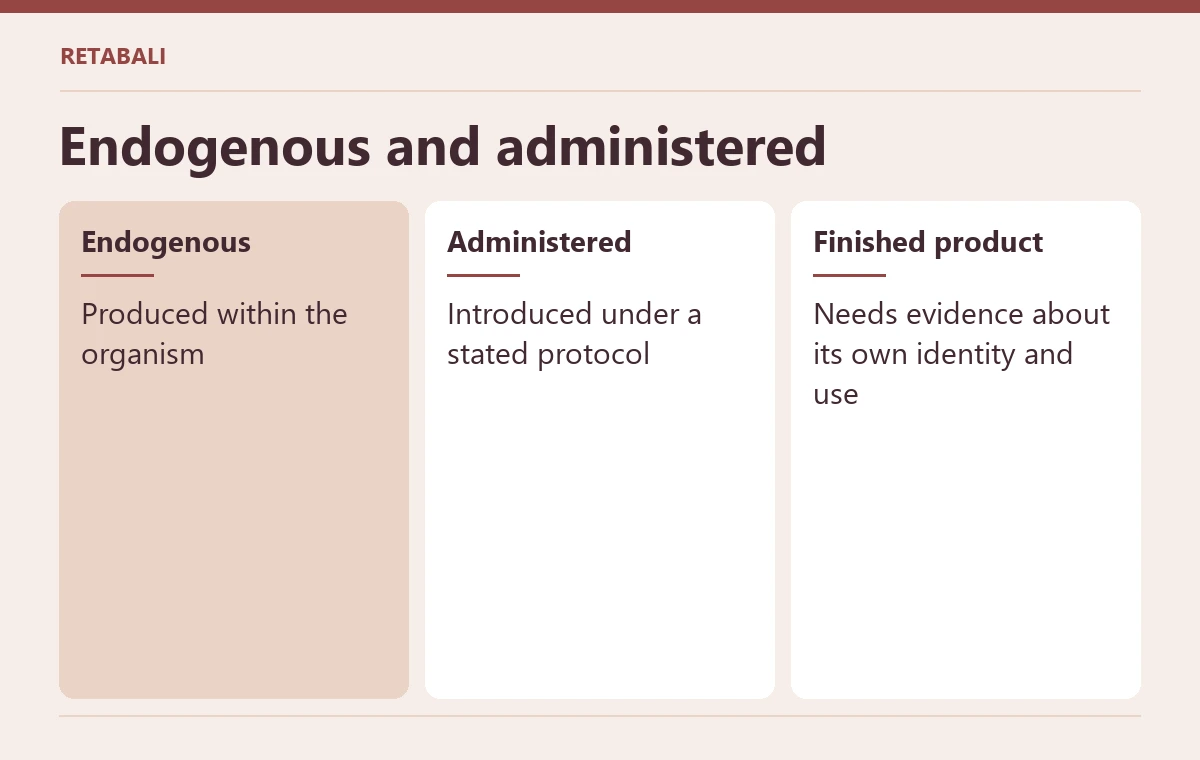
Detecting a peptide produced by the body establishes its presence under the measured conditions. It does not test the clinical effects of a finished product sold under the same name.
A name can stay the same while the experiment changes
Primary research described MOTS-c as a mitochondrial-derived peptide and studied metabolic responses in experimental systems. Later exercise work included both human measurements and animal experiments. The route and source of the peptide differ across these questions. The mitochondrial-derived peptide MOTS-c promotes metabolic homeostasis and reduces obesity and insulin resistance MOTS-c is an exercise-induced mitochondrial-encoded regulator of age-dependent physical decline and muscle homeostasis
Researchers can detect a molecule after an ordinary physiological stimulus, introduce it into a controlled experimental preparation or administer it to an organism. Each action establishes a different relationship between the molecule and what happened next. A human blood sample that contains measurable MOTS-c therefore cannot tell a reader whether administering an external product would improve human exercise capacity. It can help investigate how the body's own signalling changed under the observed conditions.
Trace the actual comparison
A reader in Bali sees a human sample labelled MOTS-c and assumes it came from someone who had purchased a pen. Check the methods for collection versus administration. A blood sample collected around exercise may contain an endogenous signal without any administered product.
Read both sides of the comparison. A participant before versus after exercise, a treated mouse versus a control mouse, and a person receiving a preparation versus a person receiving placebo are distinct pairs. A marketing summary can omit the comparator while retaining a phrase such as higher levels or improved performance. Restoring the comparator usually makes it clear which inference belongs to the evidence and where a new study would be needed.
Before sharing the claim
One way to keep the distinction visible is to give every figure a verb. Was the molecule measured, produced, administered or manipulated in a model? Changing the verb changes the claim. A label saying participants exercised before sampling supports a question about an endogenous response. A statement about what happened after an experimenter gave a compound requires an administration protocol and a comparison. A shop photograph establishes neither of those conditions. This approach also leaves room for an interesting molecular finding to be true without treating it as a product endorsement. If the reader's question concerns human performance, identify the human performance measurement rather than importing a result from a different part of a multidisciplinary paper.
For each claim identify whether the molecule was detected, added to a laboratory preparation, given to an animal or administered in a defined human trial. Those observations build different kinds of evidence.
