One exposure or repeated exposure? The two CJC-1295 protocols
A first-exposure experiment and a repeat-exposure experiment do not ask the same question.
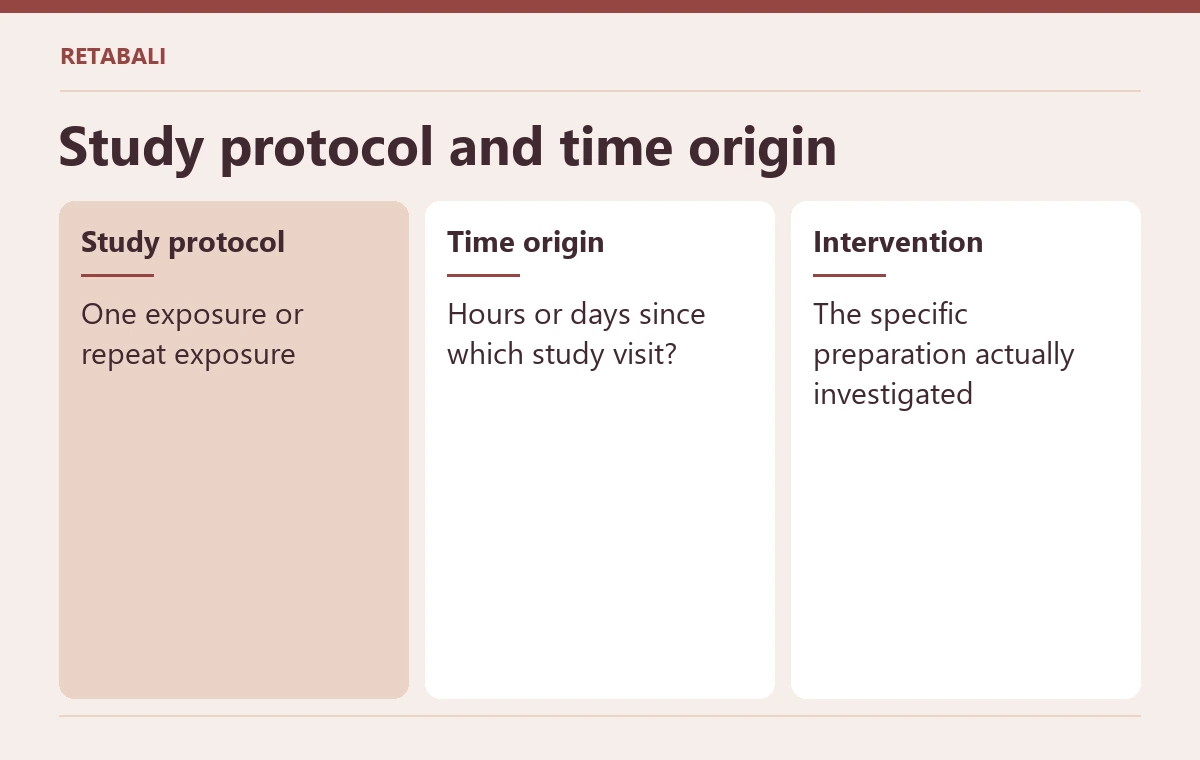
A first-exposure experiment and a repeat-exposure experiment do not ask the same question. In the early CJC-1295 human programme, both designs appeared; a result from one protocol should not silently be assigned to the other.
The first visit means something different in each protocol
The paper describes two randomised, placebo-controlled, double-blind trials in healthy adults. The researchers measured pharmacokinetics and growth-hormone-axis responses. The study preparation was long-acting CJC-1295, not a combination with ipamorelin. Prolonged stimulation of growth hormone (GH) and insulin-like growth factor I secretion by CJC-1295, a long-acting analog of GH-releasing hormone, in healthy adults
In a single-exposure study, the time since exposure and the time since first exposure coincide. With repeated exposure, the time since the first study visit and the time since the most recent exposure can be quite different. A graph can legitimately use either reference. Without its caption it may be impossible to decide which interval was plotted. Read the population, group allocation and sampling schedule alongside the graph instead of joining points from different protocols into an imaginary participant's treatment history.
Keep a pharmacokinetic result with the molecule measured
A Bali reader saves the first concentration curve from one trial and the last blood result from the second. Different participants, time origins and exposures make those points unsuitable as a single treatment history. Label the protocol on every figure before comparing its endpoints.
A concentration of the administered compound answers a question about how it was handled in the study. Growth hormone and IGF-1 measurements examine responses in a related biological system. A later change in a response marker does not establish that an identical concentration of the investigational compound persisted until that date. Likewise, an observation about a particular long-acting preparation is not evidence about an unspecified blend containing ipamorelin. If an article claims that a result supports performance or recovery, check whether either was measured in the people studied.
Before sharing the claim
When combining two charts, read what zero means on each horizontal axis. It could denote the first study visit, the most recent exposure or the moment immediately before a scheduled sample. Identical labels such as day one tell little until their reference event is known.
Even an identical sampling schedule across two protocols would not prove their populations were identical. Check eligibility and group assignment before interpreting differences across experiments as if researchers had tested those groups against each other directly.
Ask whether the claim concerns the body's handling of the compound after one exposure, the response after repeated exposure or a clinical benefit. Only consider conclusions supported by the corresponding protocol and measurements.
