What does “outgrowth” mean in a BPC-157 tendon study?
Tendon explant outgrowth describes cells moving or growing from a piece of tissue under laboratory conditions.
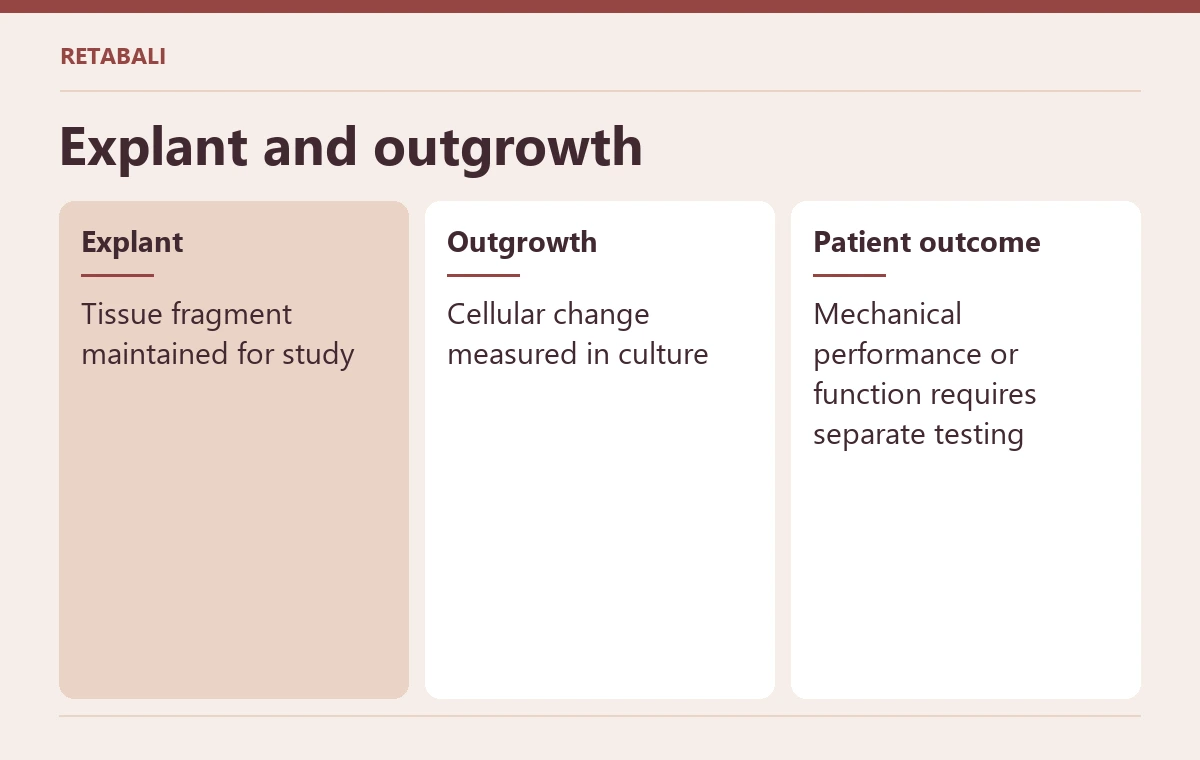
Tendon explant outgrowth describes cells moving or growing from a piece of tissue under laboratory conditions. It is not the measured regrowth of a ruptured tendon in a person.
The boundary of the tissue fragment
The primary BPC-157 paper examined tendon explants and cellular responses, including migration and signalling. A tissue fragment in culture and isolated cells permit observation of specific processes while leaving out many features of an injured, loaded tendon. The promoting effect of pentadecapeptide BPC 157 on tendon healing involves tendon outgrowth, cell survival, and cell migration
Explant studies place a defined piece of tissue in controlled surroundings so researchers can observe what happens nearby. A change in the area occupied by cells around an explant is a measurable observation. It does not by itself reveal the strength of an intact tendon under repeated loading. Different methods may also be needed to distinguish changes in cell movement from changes in cell number. Look for how the investigators defined and measured the specific endpoint rather than relying on a broad word like growth.
The next question requires a different model
Think about two measurements an athlete might care about: whether tissue resists a given load, and whether training can resume without a setback. A larger area of cellular outgrowth in an experiment is neither measurement. It can suggest a mechanism that a later study would need to test at another level.
A relevant clinical study would identify the underlying injury and define an outcome that matters to affected people. Time until a planned activity, pain during a standard task and recurrent injury during follow-up are different endpoints. Rehabilitation and initial injury severity could affect them even if the laboratory observation were completely reproducible. A study of an isolated compound also does not directly test a blend containing a second active ingredient. Retaining the tissue experiment as a mechanistic observation leaves room to ask whether any later work genuinely answered the clinical question.
Where the evidence ends
A culture observation may be repeatable and still leave the next level uncertain. An intact tendon carries load, contains several tissues and changes during a person's rehabilitation. None of those features is captured simply by enlarging the photograph of outgrowth.
When an online article calls a study a tendon experiment, check whether the experimental unit was a person, a tissue fragment, a cell culture or an animal. The shared tissue name does not tell you which type of unit was used.
When sharing the study with a clinician in Bali, quote its model and endpoint together. A commercial blend containing a second ingredient and a rehabilitation programme introduce questions the explant experiment was not designed to answer.
