Tesamorelin and liver fat: percentage points or percent?
A liver fat proportion can fall by a few percentage points and by a much larger relative percentage at the same time.
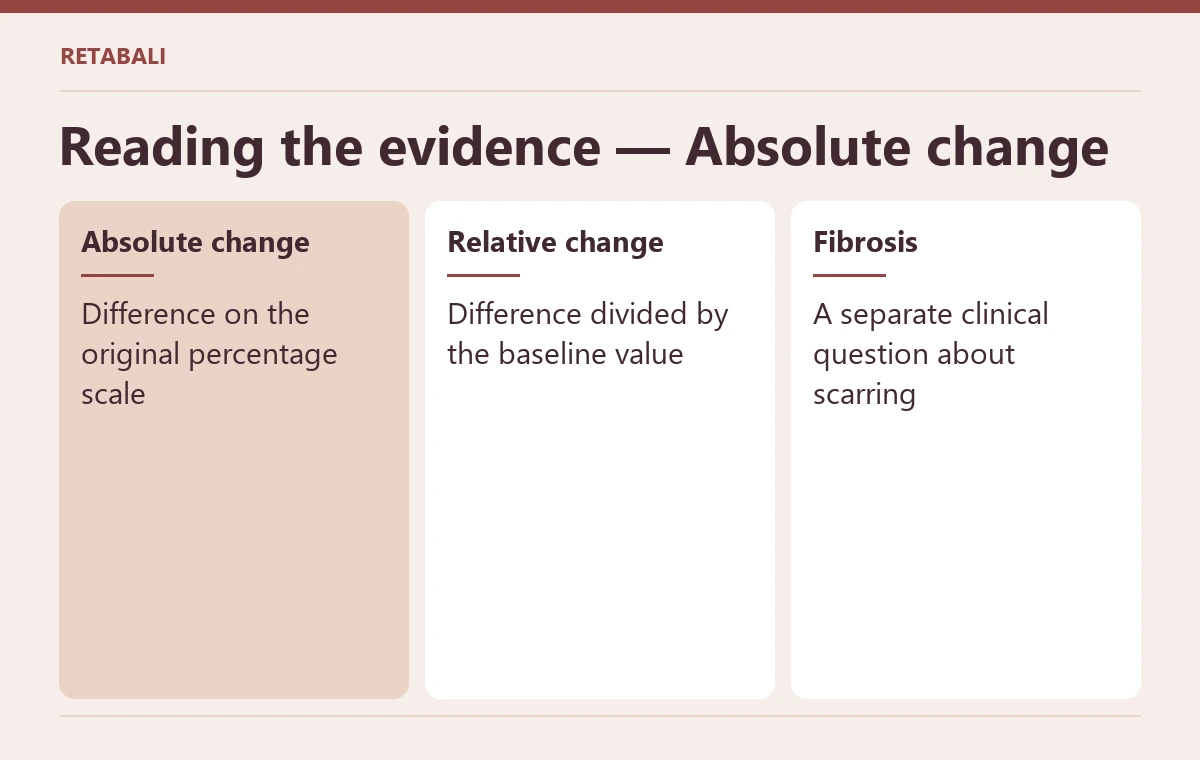
A liver fat proportion can fall by a few percentage points and by a much larger relative percentage at the same time. These are two ways of describing change. A clinical trial of tesamorelin in people with HIV and fatty liver illustrates why the denominator matters.
What a percentage point measures
The trial used the change in hepatic fat fraction over twelve months as its primary endpoint. Investigators reported an absolute treatment effect of minus 4.1 percentage points versus placebo, corresponding to a relative reduction of thirty-seven percent. That estimate comes from the trial analysis. It does not mean a thirty-seven-point fall or prove that liver scarring reversed. Randomised tesamorelin study in people with HIV and fatty liver
The arithmetic works because both values share the same percentage scale. Subtract the final proportion from the starting proportion to express a difference on that scale. To express a relative difference, compare that subtraction with the starting value. A smaller starting fraction makes the same absolute difference a larger proportion of the original. This is why a report needs the baseline, even when it prints a striking relative change in large type. In a randomised trial there is one further layer: the change in the intervention group is compared with what happened in the control group. A participant's before-and-after difference and that treatment contrast answer different questions.
A scan cannot answer every liver question
For the arithmetic alone, picture a liver fat fraction falling from ten percent to seven. That is three percentage points measured on the original scale, and thirty percent measured relative to the original ten. This invented example illustrates the calculation only; the published trial involved a comparison between groups. One individual scan pair does not recreate the study.
Hepatic fat fraction describes the share of the measured signal attributed to fat using the specified technique. Fibrosis refers to scarring. A change in fat can be clinically interesting without demonstrating a change in the stage of scarring, and a single liver enzyme in a blood panel is a different observation again. Read the outcomes section for the method used to address each question. If a paper calls one outcome primary, look for what the study was designed and sized to test before treating other findings as equally certain. The population in this trial had both HIV and fatty liver; extrapolation to a person with another cause of liver disease requires separate evidence.
How to use the finding
If a Bali clinic gives you baseline and follow-up values, keep the measurement method and dates with them. Ask whether the intended question concerns amount of fat, evidence of fibrosis or the reason for abnormal liver tests. These can require different evidence.
