Why a tesamorelin liver trial also tracked blood glucose
A trial can choose an efficacy endpoint about one organ and a safety endpoint about another physiological process.
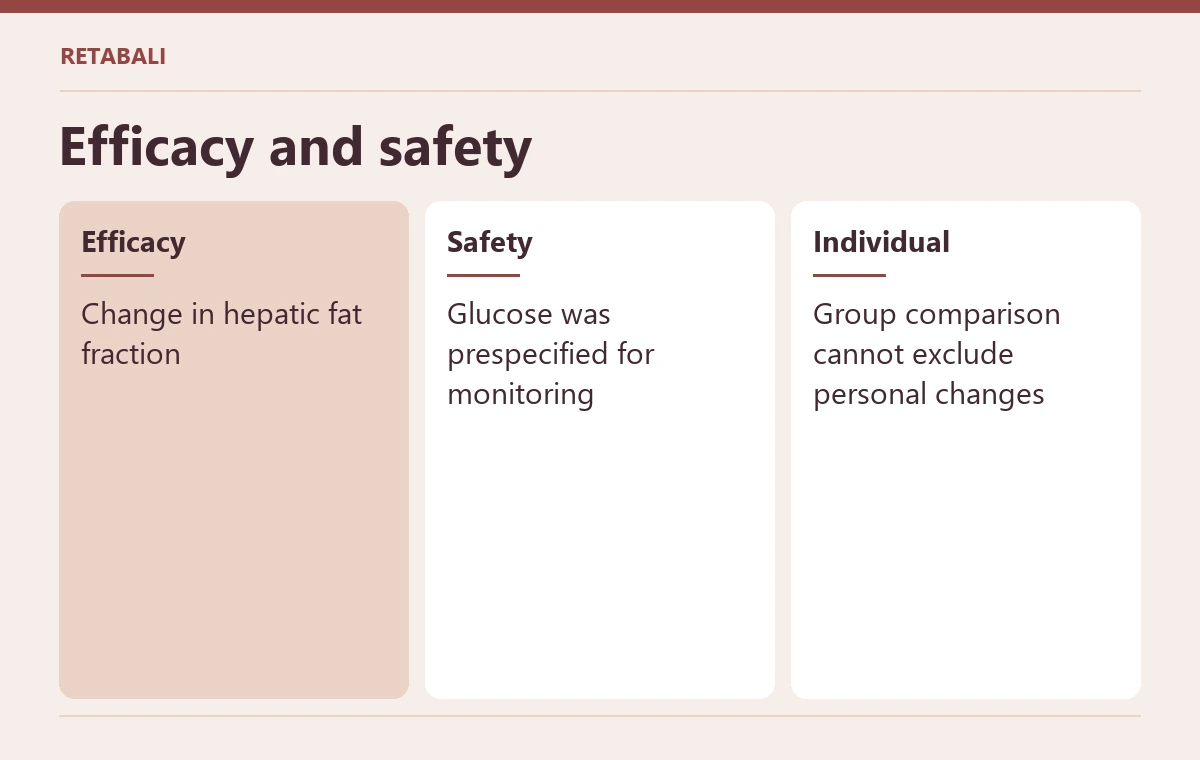
A trial can choose an efficacy endpoint about one organ and a safety endpoint about another physiological process. Reading the first without the second gives an incomplete account of the study question.
What the study was trying to learn
The randomised tesamorelin study in HIV-associated fatty liver treated liver fat change as its primary efficacy endpoint and blood glucose as its primary safety endpoint. The investigators also reported glycemic measures over follow-up. Finding no clear group difference is not proof that no participant had a glucose change. Randomised tesamorelin study in people with HIV and fatty liver
Efficacy questions ask whether treatment modifies a chosen target outcome against the comparator. Safety questions ask about unwanted changes that investigators sought to detect during follow-up. The tesamorelin study placed hepatic fat and glucose on different lines of that plan. A favourable result on a liver imaging endpoint cannot automatically be transferred to a glucose safety question. Equally, a finding about glucose does not invalidate or substitute for the imaging result. Their methods and units make each meaningful in its own context.
What a comparison can rule out
A Bali reader compares an individual glucose value with the study's average. The average may remain stable while individuals move in both directions. Ask whether the number is a change from baseline or a difference between groups, and whether uncertainty is reported.
A study can estimate a difference between groups with a particular degree of uncertainty. A result described as similar between groups is not the same as a proof of zero effect under every circumstance. Consider sample size, follow-up, starting glucose and the clinical population when reading the safety information. If an individual in Bali is discussing glucose observations with their clinician, keep the actual measurements, their times and current glucose-lowering treatment with the report. The study cannot identify the cause of one person's change, still less guarantee the effects of a different formulation.
What belongs in a personal discussion?
Look at the clinical question attached to a particular glucose measure. A single fasting value and HbA1c summarise different periods. Agreement in the broad group comparison does not make them equivalent measurements.
Safety observations are also specific to the period under study. A comparison at the final scheduled visit cannot exclude an earlier transient change unless such changes were captured and analysed. Use the time window attached to the result rather than an unqualified statement about safety.
Keep liver imaging, fasting glucose and HbA1c as distinct outcomes in the notes taken to clinic. Findings in the trial population cannot establish safety for all people or all preparations.
