When a diabetes trial participant needs rescue medicine, what happens to their result?
A later glucose reading can matter even after an additional treatment starts. Whether it answers the trial's main question depends on the effect the researchers set out to estimate.
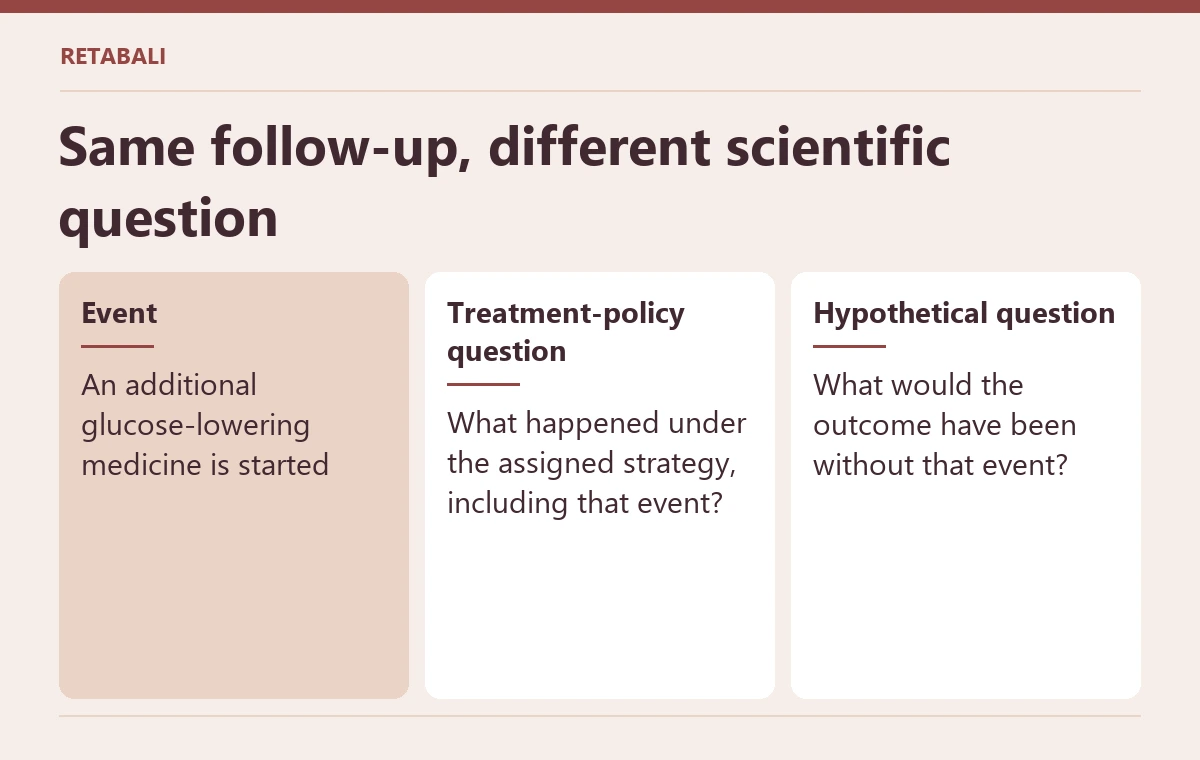
Consider a participant assigned to a diabetes treatment who later needs an additional glucose-lowering medicine. They continue coming to visits and provide another HbA1c sample. The value is genuine. The harder question is what that value represents: the outcome after assignment to a strategy that allowed rescue, or the outcome that might have occurred if rescue had never been needed?
Start with the event, not the statistical software
Starting additional treatment after randomisation can be an intercurrent event. The ICH E9(R1) guideline on estimands discusses how researchers define the treatment effect of interest and specify how such events relate to it. An estimand is the precise question. The estimate is the number produced by analysing data to answer it. A single trial can set out more than one question.
A missed blood draw is a different problem. It creates missing data for a planned measurement. A participant may start rescue treatment and still have complete follow-up data, or remain on a study medicine and miss a visit. Marking both situations simply as “dropouts” throws away a distinction that the analysis needs.
Follow one participant through two possible questions
A treatment-policy question asks about outcomes following assignment in a setting where the specified event can occur. A later HbA1c can be relevant to that question even after rescue. A hypothetical question asks about a scenario in which the event did not occur. Once the participant actually received the extra treatment, their subsequent measurement cannot directly reveal their personal outcome in that hypothetical scenario. Estimation requires assumptions and an analysis appropriate to the question.
This example does not tell you that every tirzepatide trial used the same strategy. Investigators specify the relevant population, variable, comparison and handling of particular events in their protocol and analysis plan. Look up what the paper did rather than guessing from the treatment name.
Read the footnote before comparing the percentages
If two headlines about a diabetes medicine quote different changes, find the endpoint, time point and estimand under each figure. Different questions can legitimately produce different answers. For someone reading the research in Bali, the helpful distinction is whether a number describes outcomes with the additional care that occurred or a defined hypothetical course. Neither figure is a personal prediction or an instruction to delay additional care to make one's experience resemble a trial.
