Somatropin in the foresiGHt trial: what did trunk fat percentage measure?
The adult growth hormone deficiency trial measured trunk fat percentage by DXA. Its primary comparison, regional fat mass and total lean mass answer different questions.
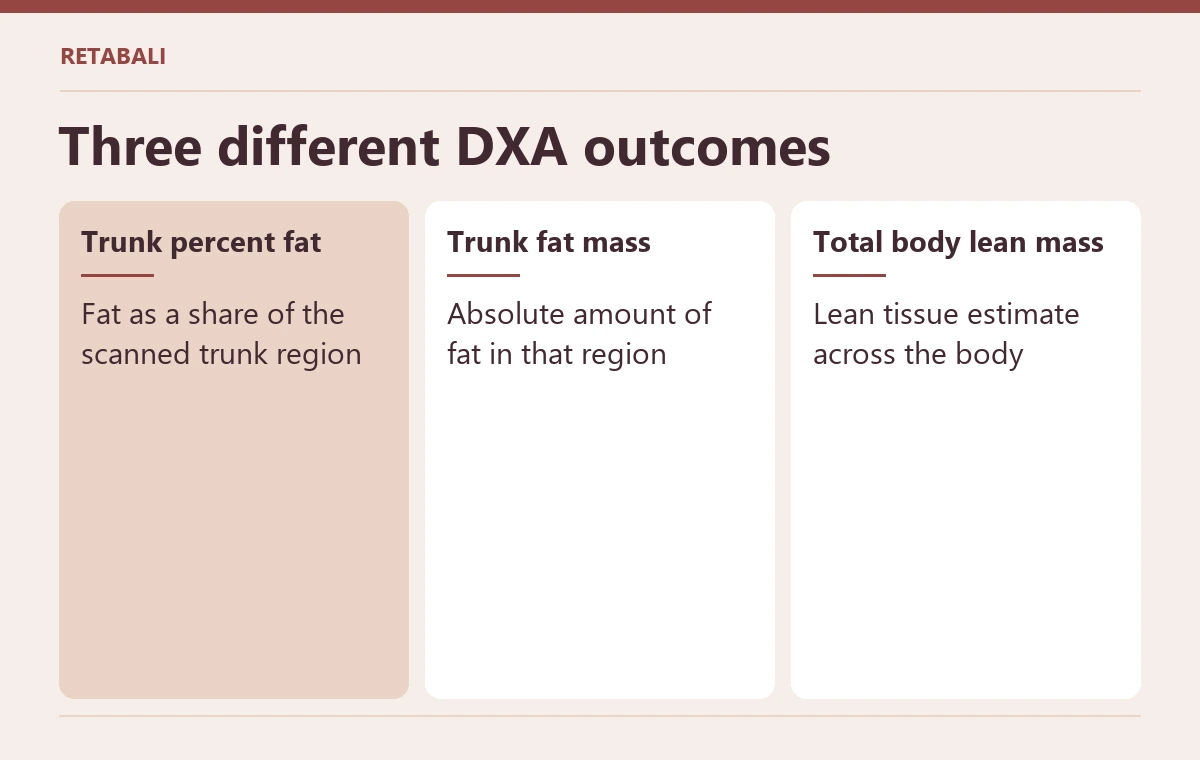
The main body-composition result in foresiGHt concerned fat as a percentage of the trunk region on a DXA scan. It did not measure the percentage change in body weight, and it did not isolate the fat surrounding the abdominal organs. The trial studied adults with growth hormone deficiency. That population matters to a Bali reader considering what the research says about somatropin.
Which scan and which treatment comparison?
The study randomly assigned adults with growth hormone deficiency to weekly lonapegsomatropin, weekly placebo or daily somatropin. Lonapegsomatropin is a long-acting prodrug that releases somatropin. The weekly active treatment and placebo were blinded, while the daily somatropin arm was open-label. Those distinctions matter because a finding credited to the weekly treatment versus placebo cannot simply be rewritten as a finding about the daily arm or as a direct result for an unnamed pen. Primary foresiGHt trial publication
The registered primary endpoint was the change from baseline in trunk percent fat at week 38, assessed by dual-energy X-ray absorptiometry. The trial also listed change in the mass of trunk fat and change in total body lean mass as secondary endpoints. Keeping those three lines separate makes the study easier to interpret than the broad phrase “body composition improved.” Registered outcomes and measurement method
Why a regional percentage can change without the same change on the scale
Imagine a simplified region of a scan containing twenty units of fat within one hundred units of tissue. If the region later contains eighteen units of fat within ninety units of tissue, the fat amount has fallen but its share is still one fifth. This is an arithmetic example, not a result reported for trial participants. It shows why a fraction and an amount can move differently when both the numerator and denominator change.
There is another boundary to keep in mind. The trunk region contains more than visceral fat. A reported change in total fat within that region cannot by itself identify which compartment accounts for the change. Nor does total body lean mass tell us the strength of a particular muscle. Those questions require measurements suited to the tissue or function involved.
What to ask when a scan is described in Bali
Ask for the actual scan region, unit and comparison date. Write down whether the value is a percentage of tissue in the trunk, an absolute regional mass, or total body weight. Check whether the original paper is describing change within one group or a contrast against placebo. If your personal question concerns growth hormone deficiency, a DXA figure alone cannot diagnose it. Review the clinical history and the purpose of the examination with the treating endocrinologist. Results obtained in diagnosed adults do not establish a body-composition indication for a person who has never had that diagnosis.
