Does blinding tell us whether an NAD precursor improved fatigue?
Blinding can reduce bias in the measurement of outcomes a trial actually collected.
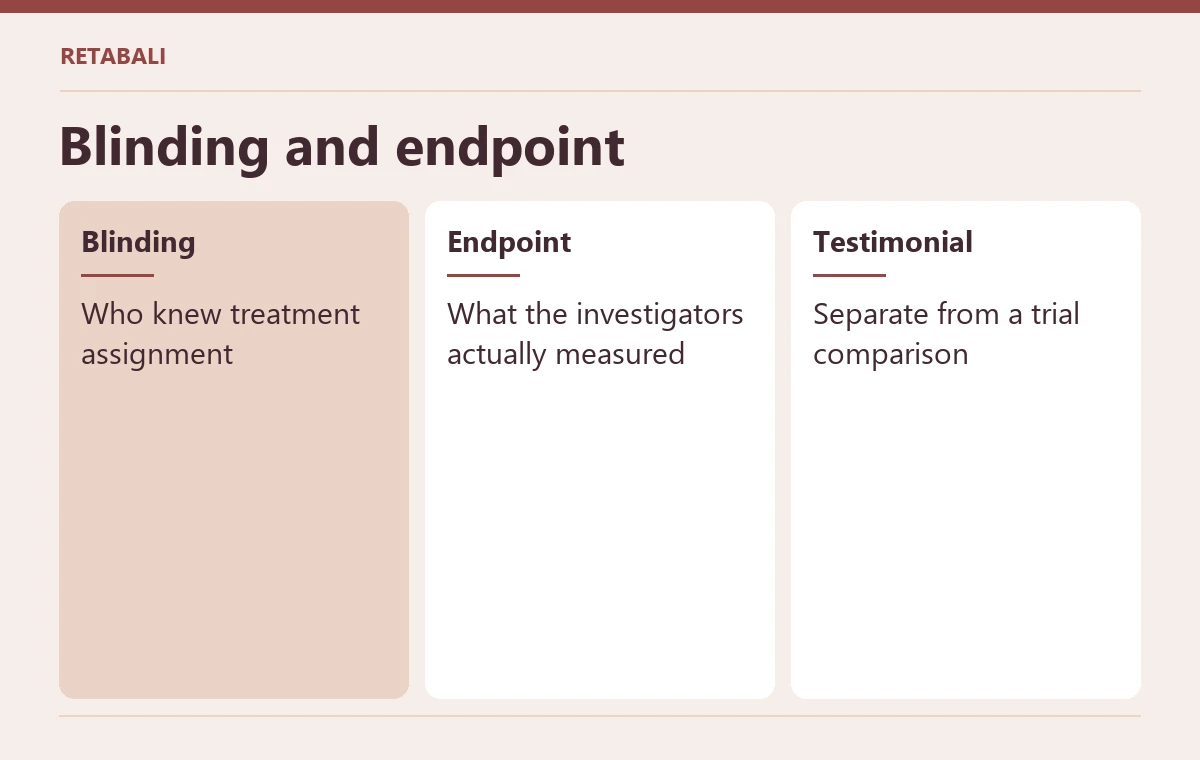
Blinding can reduce bias in the measurement of outcomes a trial actually collected. It cannot create a fatigue result when fatigue was not the endpoint behind the reported finding.
Blinding cannot add an endpoint
A crossover trial of oral nicotinamide riboside in healthy middle-aged and older adults measured biochemical and physiological outcomes. The design and the named precursor matter. Read each tested outcome before converting a reported biomarker change into a claim about feeling more energetic. Chronic nicotinamide riboside supplementation is well-tolerated and elevates NAD<sup>+</sup> in healthy middle-aged and older adults
Suppose the participants and investigators do not know who receives a precursor during a study period. That helps limit expectation-related differences for observations actually collected. If the available result concerns a biochemical marker, however, blinding does not transform the marker into a measure of subjective fatigue. Look for a defined question, instrument or functional test, its planned timing and the comparison in the results. A statement that a study was blinded answers who knew an assignment. It does not answer what anyone measured.
Do the preparation and population match the claim?
A Bali reader sees double-blind on a product page next to a testimonial. Those two elements do not establish that the testimonial came from the trial or that the trial measured the same symptom. Look for a defined fatigue questionnaire and its comparison, rather than the study-design label alone.
The human study concerned oral nicotinamide riboside in a defined group of adults. A product with a different route or substance and a person seeking care for persistent fatigue raise different questions. A testimonial may be honestly reported without being a controlled observation, and a biomarker experiment may be well conducted without establishing a benefit for the symptom. A useful clinical account describes when tiredness began, which activities changed and which other symptoms accompanied it. That information helps the clinician consider causes rather than inferring one from a study-design label.
Before sharing the claim
An outcome is easiest to identify in the methods or registered outcome list, where the measurement and time point should be stated. An attractive testimonial beside the citation provides neither the denominator nor the comparison needed to recover a treatment effect.
When another study is cited for the symptom claim, verify that the population, intervention and measure belong to that second study. A collection of citations is not itself a composite trial in which every cited result can be assigned to every tested product.
If fatigue is the personal concern, describe onset, functional impact and other symptoms to a clinician. A group finding about NAD metabolism cannot identify the cause of an individual's tiredness or establish a benefit from an unrelated formulation.
