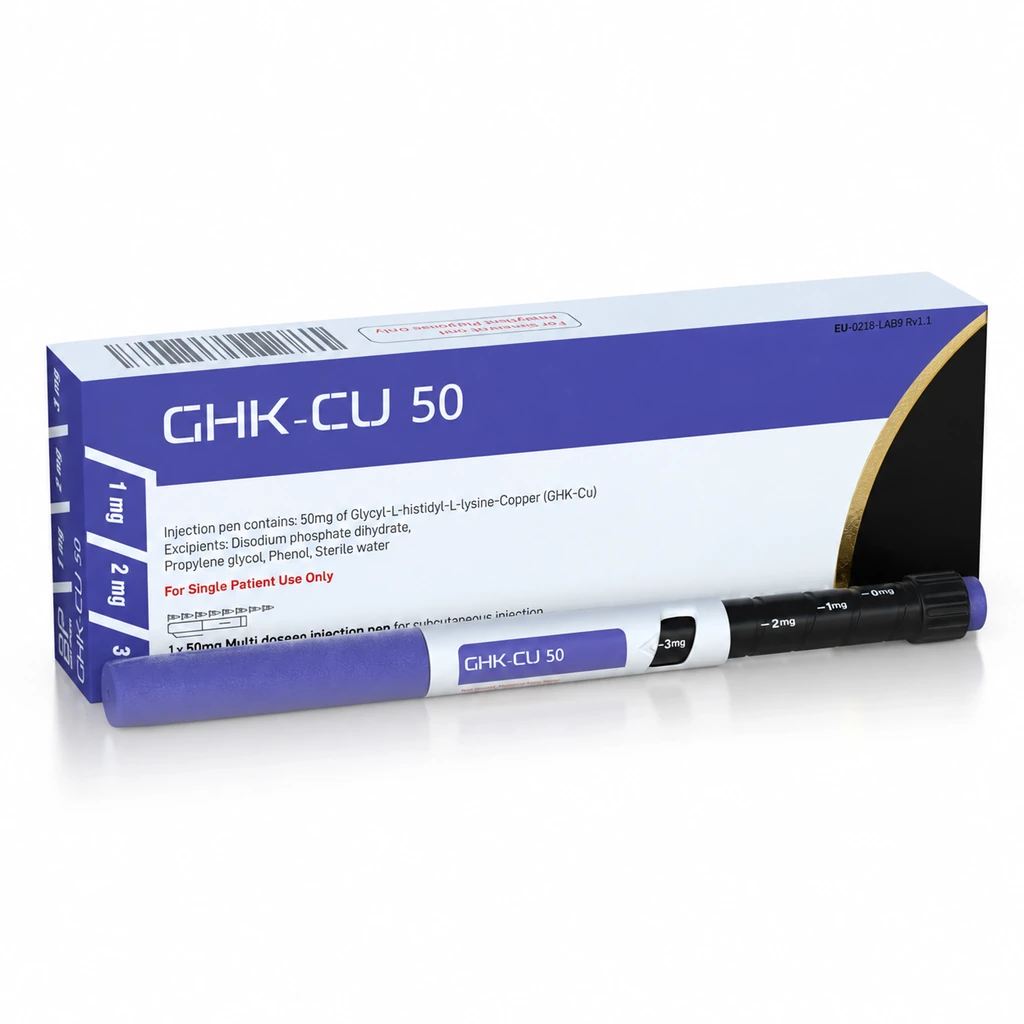
GHK-Cu and retinol are different ingredients with different research histories. Retinol is a form of vitamin A commonly discussed in topical skincare; GHK-Cu is a copper-binding peptide complex. For shoppers in Bali, comparing a retinol cream with a GHK-Cu pen requires more than choosing a preferred ingredient: the product route changes which evidence is relevant.
GHK-Cu vs retinol: start with the product, not the slogan
| Comparison point | GHK-Cu | Retinol |
|---|---|---|
| Ingredient type | Copper-peptide complex | Vitamin-A derivative |
| Example of evidence discussed here | Collagen synthesis in fibroblast cultures | Controlled application to aged human skin |
| Product question | Serum, cream or pen? | Concentration and complete topical formulation? |
| Main comparison trap | Treating cell or serum evidence as proof for a pen | Treating every retinol formula as identical to a study product |
“Supports collagen” can describe very different levels of evidence. A laboratory measurement, an investigator's assessment of skin and a shopper's impression in the mirror are not interchangeable outcomes. The first useful question is what was measured, in whom and using which formulation.
What the studies can tell us
An early GHK-Cu fibroblast study investigated collagen synthesis in cell culture. It provides biological context for interest in the ingredient. It did not test the cosmetic result of a commercially offered pen in people, nor did it compare that pen against retinol.
A controlled retinol study applied a topical formulation to naturally aged skin and assessed changes over time. This is evidence concerning a particular preparation, population and body site. It should not be expanded into a guarantee about every face cream, every age group or an unrelated injectable product.
These sources therefore do not produce a head-to-head winner. They explain why asking only which ingredient is “stronger” misses the main issue: the available evidence may concern entirely different types of product and outcome.
A peptide pen is not a concentrated skincare serum
The GHK-Cu listing describes a 50 mg pen. That number states total product contents. A topical percentage describes concentration within a cream or serum. There is no useful direct conversion that makes 50 mg in a pen equivalent to a percentage printed on a retinol bottle.
The route also changes the safety questions. A product intended for skin application cannot supply an injection protocol, and a cosmetic ingredient's reputation does not establish the safety of another route. The FDA's peptide assessment specifically discusses limitations around injectable GHK-Cu. This is not an assessment of our individual batch or a statement of Indonesian approval.
Match the comparison to your skin question in Bali
Separate three common goals: how skin looks, how it feels and a medical skin condition. A fine-line concern, a dry or irritated feeling and a persistent lesion need different kinds of assessment. Naming all three “anti-ageing” can hide those differences rather than help you choose.
If your routine changes while staying in Canggu or Seminyak, keep a record of the complete products already used and any new irritation. Take that information to a dermatologist or another qualified clinician. A locally convenient order is useful commercially, but it does not settle which formulation fits your skin or whether a medical concern needs evaluation.
For a product discussion, ask for the actual format and available documentation. For a skincare discussion, bring the full ingredient lists rather than isolated ingredient names. Our GHK-Cu and bakuchiol comparison illustrates the same need to distinguish botanical cosmetics, peptide names and specific evidence, without making them interchangeable.
Questions buyers ask
Can GHK-Cu replace retinol?
The studies cited here do not establish that a GHK-Cu pen replaces a topical retinol regimen. Replacement is a product- and person-specific question. A shared interest in skin appearance does not make two routes equivalent.
Is the copper peptide automatically gentler?
A tolerance claim about a cream cannot be transferred to a pen. “Gentler” also needs a clear meaning: irritation, systemic effects and suitability are different questions. Compare the exact products and evidence instead of ranking ingredients by reputation. The peptide catalogue identifies the available formats; it does not rank them as skincare substitutes.
Sources & further reading
Educational information. For personal treatment decisions and instructions, consult a qualified clinician or pharmacist with the details of your exact product.