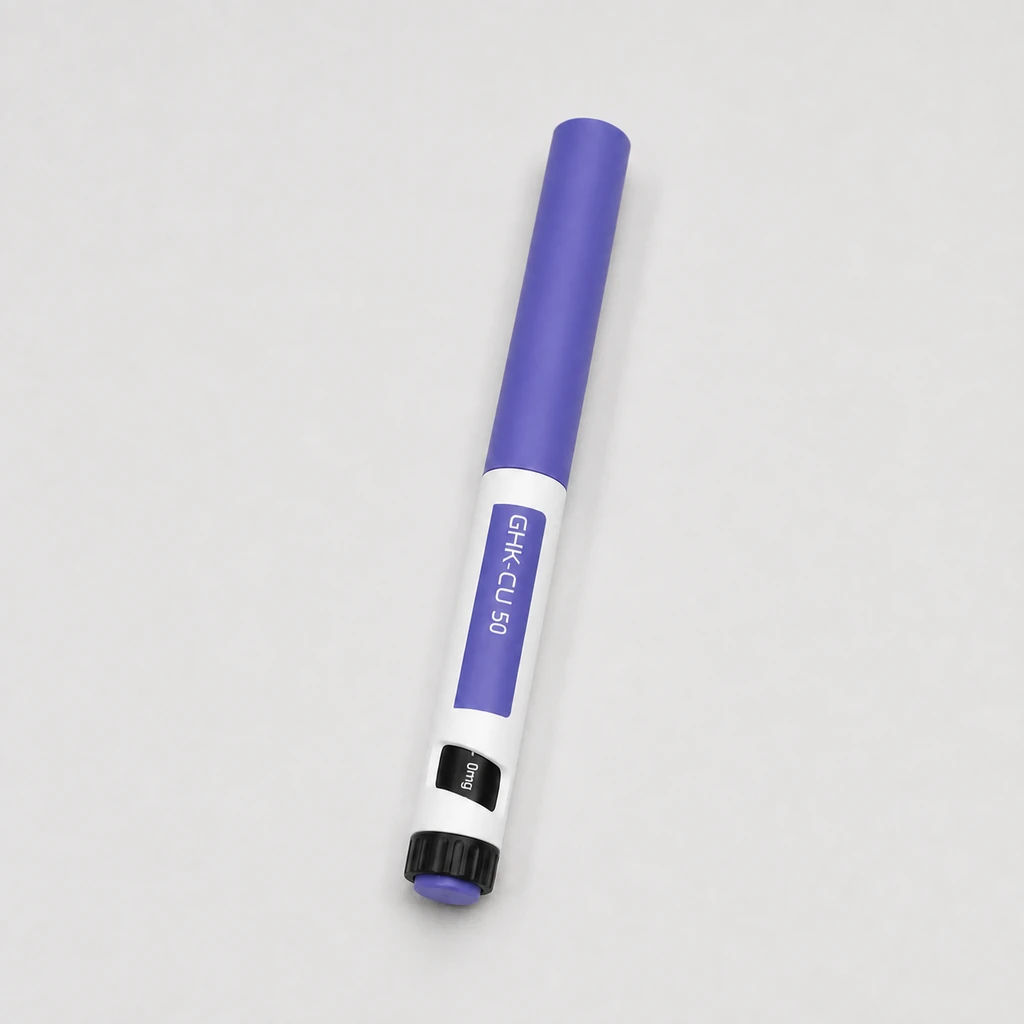
A GHK-Cu pen is not simply a stronger version of a copper-peptide serum. In Bali, those offers describe different finished products and routes, so evidence for a cosmetic formula cannot automatically establish the effects or safety of a pen. The catalogue lists a 50 mg GHK-Cu pen; it does not list a topical serum.
One ingredient name can describe different products
You may encounter GHK-Cu in a cosmetic ingredient list, a research vial advertisement or a prefilled pen listing. The shared name helps identify the ingredient being discussed. It does not make the products equivalent.
For a serum, relevant details include the complete formula, the intended skin application and any evidence for that finished cosmetic. For a pen, the questions concern the exact preparation, container, intended route and appropriate product documentation. A photograph of blue liquid answers neither set of questions.
| Comparison point | Topical serum | Catalogue GHK-Cu pen |
|---|---|---|
| Product format | Cosmetic formulation applied to skin | Prefilled pen |
| Amount description | May show a percentage or an ingredient list | 50 mg total labelled contents |
| Evidence that would be relevant | Study of the actual topical formula and outcome | Study matching the preparation, route and outcome |
| Invalid shortcut | Ingredient appears in a paper, so the serum is proven | Serum or cell findings prove the pen works better |
The GHK-Cu product page is the place to identify the offered pen. A serum discussed elsewhere in this comparison is not an additional catalogue product.
What the familiar collagen study measured
The early GHK-Cu study in fibroblast cultures investigated collagen synthesis in cells. It is relevant to the scientific interest in copper peptides. It did not compare a facial serum with a retail pen, and it did not measure a shopper's wrinkles after using either product.
This distinction is easy to lose when a product page places “collagen” beside a photograph of skin. The presence of a biological mechanism does not supply a finished-product result. The missing bridge is a suitable study of the intervention and outcome actually being claimed.
When evaluating a citation, write down the test material, setting and endpoint. “Cells exposed to GHK-Cu; collagen synthesis measured” is a clearer description than “clinically proven skin rejuvenation”.
Milligrams and cosmetic percentages do not make a potency ranking
The pen's 50 mg figure describes its declared total contents. A cosmetic percentage describes a proportion in a formulation. These are different kinds of numbers. Neither alone tells you how much reaches a particular tissue or what visible effect follows.
Even if you could calculate an ingredient mass in a bottle, you would still have different formulations and routes. Arithmetic does not solve that biological difference. Avoid tables that divide the two figures and announce that one product is a multiple “stronger”.
Likewise, more blue colour is not a validated assay of concentration or purity. Product identity and quality need documentation, not a visual comparison between two promotional photographs.
Route-specific safety information matters
The FDA's assessment of substances with potential safety risks explicitly discusses GHK-Cu for injectable routes, including immunogenicity concerns associated with aggregation and peptide-related impurities. This is a route-specific concern. It is not a batch test of the catalogue pen or a claim that a cosmetic formula has been evaluated as an injectable.
A topical product should not be injected or repurposed for another route. Nor should the appearance of a pen be treated as proof of sterility or an appropriate personal treatment. Those questions require information about the actual product and qualified clinical assessment.
Our GHK-Cu and retinol comparison examines two different ingredients. Here the key distinction is different finished products bearing the same copper-peptide name.
Compare offers around your actual question in Bali
If you want to compare skincare products, bring the complete ingredient lists and the specific appearance concern to a suitable clinician. If you are evaluating a pen offer, keep the full product description and its documents separate from a cosmetic routine.
For a commercial enquiry, specify “GHK-Cu 50 mg pen”, quantity and your Bali location. Ask which documents identify the exact supplied item. Do not let a response about a serum or research vial stand in for the pen you meant.
This also prevents a common misunderstanding when moving between local suppliers: the same short ingredient name can retrieve a different format. Compare the format before discussing the order arrangements.
Questions buyers ask
Does bypassing the skin mean a better cosmetic result?
The sources cited here do not demonstrate that comparison. A different route is not, by itself, evidence of better visible results or lower risk.
Can the pen replace my serum?
There is no established product equivalence in this comparison. The pen is not a cosmetic refill, and the serum's instructions cannot be transferred to it.
What would a useful head-to-head study need?
It would need clearly specified products, relevant participants and comparable outcomes, with safety assessed for each route. A cell experiment or separate before-and-after photographs do not provide that comparison.
Sources & further reading
Educational information. For personal treatment decisions and instructions, consult a qualified clinician or pharmacist with the details of your exact product.