Can an ingredient list tell you the percentage of copper peptide?
An ingredient's place on a cosmetic label rarely gives its exact percentage.
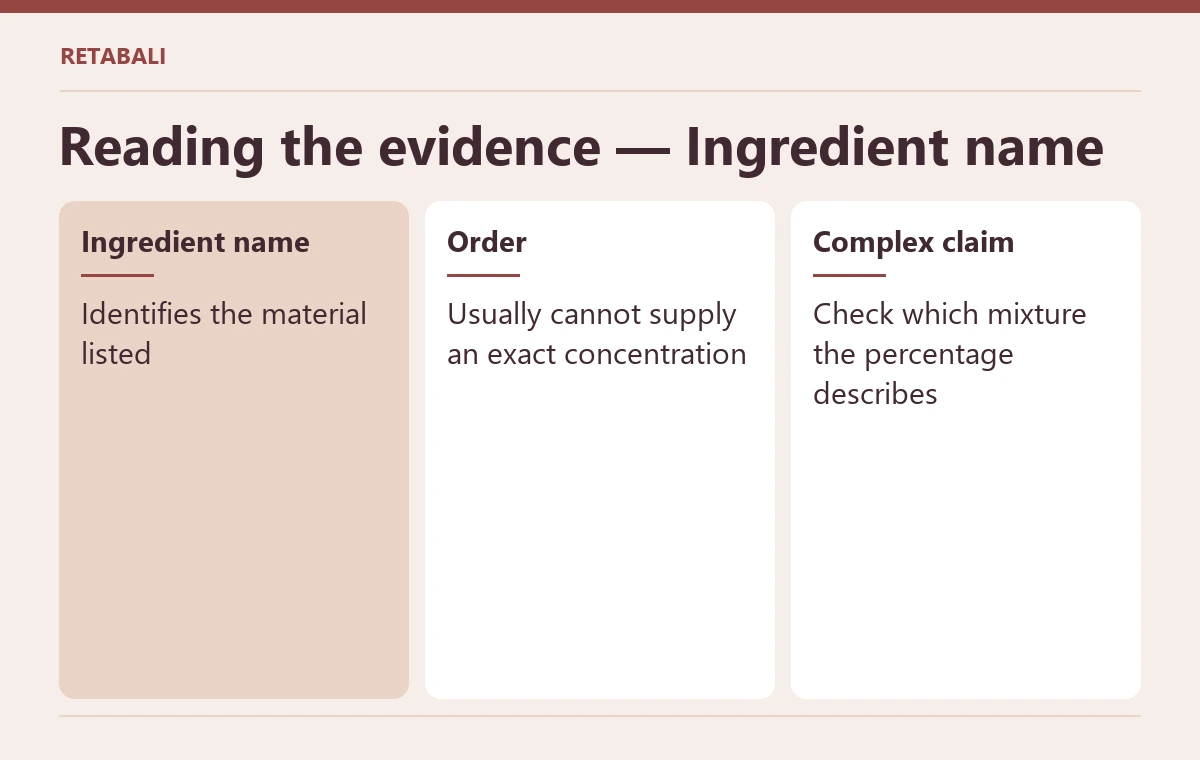
An ingredient's place on a cosmetic label rarely gives its exact percentage. Under United States labelling rules, ingredients present at one percent or less can be listed in any order after ingredients above one percent. The position of Copper Tripeptide-1 near the end of a list therefore cannot establish a precise concentration.
Read the rule for the label's own market
The FDA's cosmetics labelling guide explains the general descending order of predominance, the exception for low-concentration ingredients and distinct provisions for colours. These are US rules. A reader in Bali looking at an imported label should first identify its intended market and distinguish a finished topical cosmetic from any preparation intended for another route. US FDA guide to cosmetic ingredient declarations
The identifying ingredient name and the marketing headline often occupy different sides of a bottle. They do different work. The ingredient declaration lists materials according to applicable rules, while a front claim may refer to a proprietary mixture. Even if a supplier discloses the percentage of a mixture in the finished formula, that does not tell you the precise share of each component inside it. It would take an additional concentration statement on the same basis to calculate that figure. An online shop can reproduce the manufacturer's wording without adding the detail needed to perform that calculation. A photograph of both panels makes the ambiguity easier to show.
Identify which document could resolve the ambiguity
Imagine two lists that both name the same peptide after a preservative. Without the formulation, a claimed percentage based on that order would be guesswork. A marketing statement about a peptide complex raises another question: does the stated percentage refer to the complete supplied mixture, the finished serum, or the active ingredient within that mixture?
A complete ingredient panel may resolve whether the named peptide appears in a product. A manufacturer statement describing the finished formulation could clarify what an advertised percentage means. Neither document automatically supports a claim about benefit at a particular concentration or about the suitability of applying a product by another route. Those are different evidence questions. A shopper comparing two serums can therefore record the information actually disclosed by each and leave the concentration field blank where it is unknown. Do the same for the intended market. A US labelling explanation can illuminate an imported package without establishing which Indonesian registration or other local requirements apply to that item.
The next conversation
When asking the manufacturer for clarification, copy the full product name and the precise claim. For a skin consultation, bring photographs of the ingredient panel and the front claim so that the dermatologist can see which form you actually used.
