BPC-157 and tendon fibroblasts: what actually grew in the experiment?
A paper about BPC-157 and growth hormone receptors describes isolated cells from rat Achilles tendons.
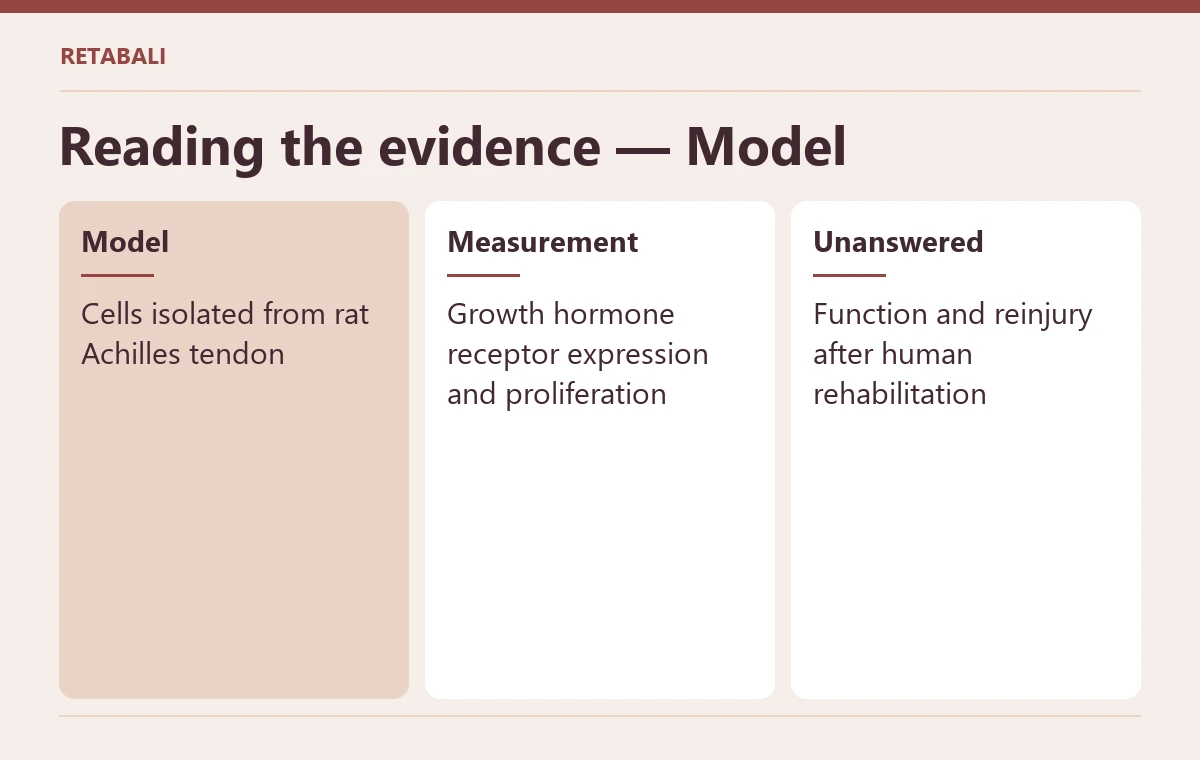
A paper about BPC-157 and growth hormone receptors describes isolated cells from rat Achilles tendons. The researchers measured changes in receptor expression and cell proliferation under experimental conditions. They did not measure how quickly an injured person could return to running or surfing.
From a receptor measurement to a tendon question
The investigators examined messenger RNA and protein levels after exposing tendon fibroblasts to BPC-157. When they added growth hormone to treated cells, they observed changes in laboratory measures of proliferation. Changing receptor expression in a dish is a mechanistic observation. It does not by itself establish tendon strength, pain relief or sport readiness in people. Primary experiment in rat tendon fibroblasts
Messenger RNA and protein measurements are two different ways to investigate what a cell is doing. An increase in a receptor's signal can give researchers a reason to examine how that cell responds when the corresponding hormone is added. The steps belong to a chain of hypotheses. A meaningful tissue endpoint would need to show how cells, their surroundings and the mechanical demands on a tendon interact. A meaningful patient endpoint would need to show what happens to pain, activity or reinjury under real conditions. Moving from one level to the next requires a new type of observation; more dramatic language about the first experiment cannot supply the missing observation.
Design a fair question about returning to sport
Consider an athlete in Bali who can now walk comfortably but cannot tolerate hopping. A paper about a receptor cannot say when to resume hopping. A clinical return-to-activity study would need to define the injury, compare appropriate groups, specify rehabilitation and follow actual participants long enough to measure function and setbacks.
Imagine comparing two groups with different initial injuries. If one group begins with milder problems, an earlier return to sport might be explained by that difference alone. If the groups receive different rehabilitation, rehabilitation could also contribute. This is why a convincing human comparison would describe how injuries were diagnosed, how treatment and rehabilitation were allocated, what counted as a return and whether participants were followed for setbacks. The fibroblast experiment was built to explore a biological mechanism and cannot settle those design questions. A retailer's combination of two ingredients introduces another layer: even a positive study of one isolated compound would not directly test the finished combination.
What to bring to a consultation
Keep the intervention as precise as the outcome. This experiment investigated BPC-157, whereas a catalogue blend may name both BPC-157 and TB-500. A second ingredient and a different route or formulation create separate evidence questions. Take the paper's actual endpoints to the rehabilitation discussion.
