Cell migration or cell division in a BPC-157 paper?
More cells visible in an area can reflect movement, division or both.
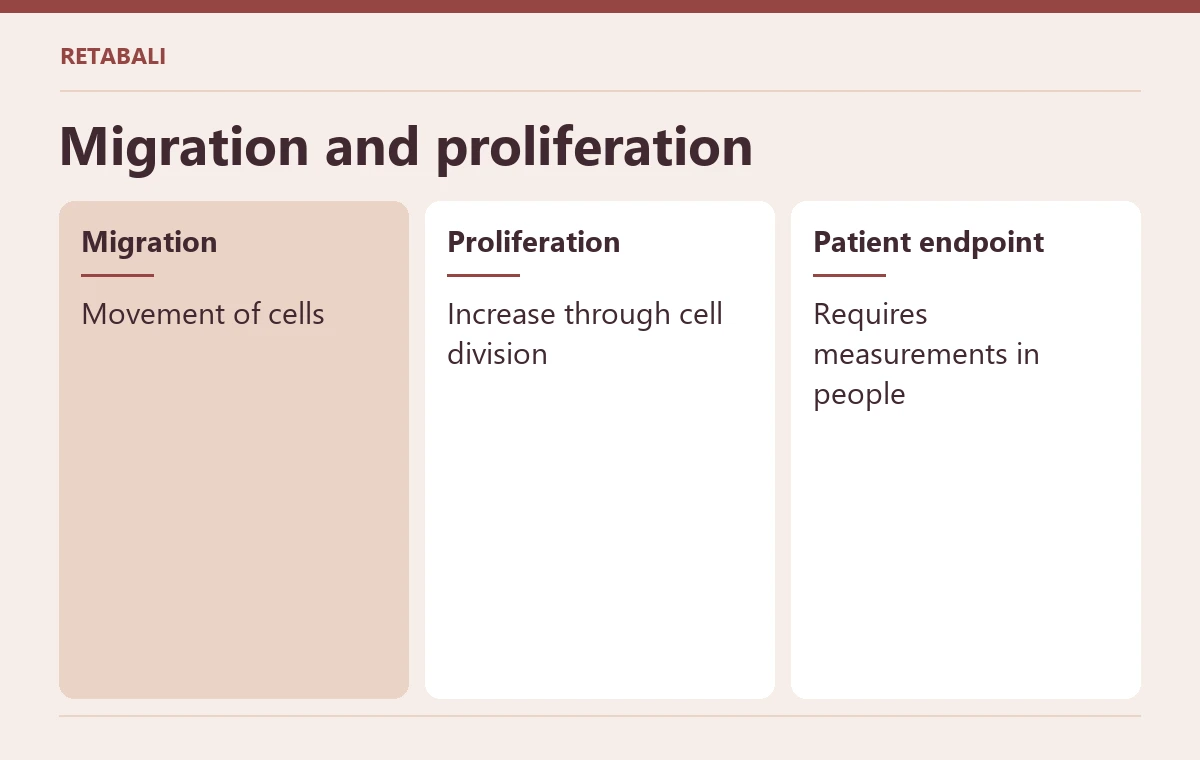
More cells visible in an area can reflect movement, division or both. Researchers need experiments designed to distinguish migration from proliferation. The title of a tendon paper is too broad to settle which process was observed.
The observation needs an experimental definition
BPC-157 experiments on tendon-derived cells used specific assays to investigate migration, signalling and growth-related responses. A later study examined growth hormone receptor expression in rat tendon fibroblasts. Each measurement supports a narrower claim than “tendon repaired.” The promoting effect of pentadecapeptide BPC 157 on tendon healing involves tendon outgrowth, cell survival, and cell migration Primary experiment in rat tendon fibroblasts
A gap in a layer of cells may narrow over time. To learn what contributed, investigators need to define the preparation, timing, images or counts and any methods used to separate movement from growth in cell number. A mechanistic marker, a cell count and a photograph of an occupied area can each answer a narrower question than a headline about healing. Read the particular figure and methods before treating every positive-looking change as evidence of the same process.
Two studies need not be one experiment
A hypothetical experiment photographs a gap before and after cells spread into it. The photographs alone do not identify how much change came from cells entering the space versus multiplying. Read how the original investigators designed their assay and which influences were controlled.
The migration and signalling work and the growth-hormone-receptor work are distinct studies. A result obtained after adding another factor under one experimental condition cannot be assigned to the cells in a different experiment without justification. A person interested in human rehabilitation has a further gap to bridge. A mechanically functioning tendon involves many cells, surrounding structures and loading over time. Clinical recovery also depends on the injury and rehabilitation. Neither a cell migration assay nor a proliferation marker contains those observations. A mechanistic result can guide a new question without establishing a return-to-sport protocol.
Where the evidence ends
Check the assay attached to each verb before interpreting the photograph.
Read what the experimental unit was for each comparison. Several measurements of cells from the same preparation provide a different kind of replication from several independent animals or people. Counting photographs without knowing where the sampled cells came from can give a misleading impression of how many independent biological observations support an inference.
In a Bali discussion about human injury, keep the model and endpoint beside the cited figure. None of these cell measurements directly records return to sport, mechanical failure or recovery with a commercial multi-ingredient product.
