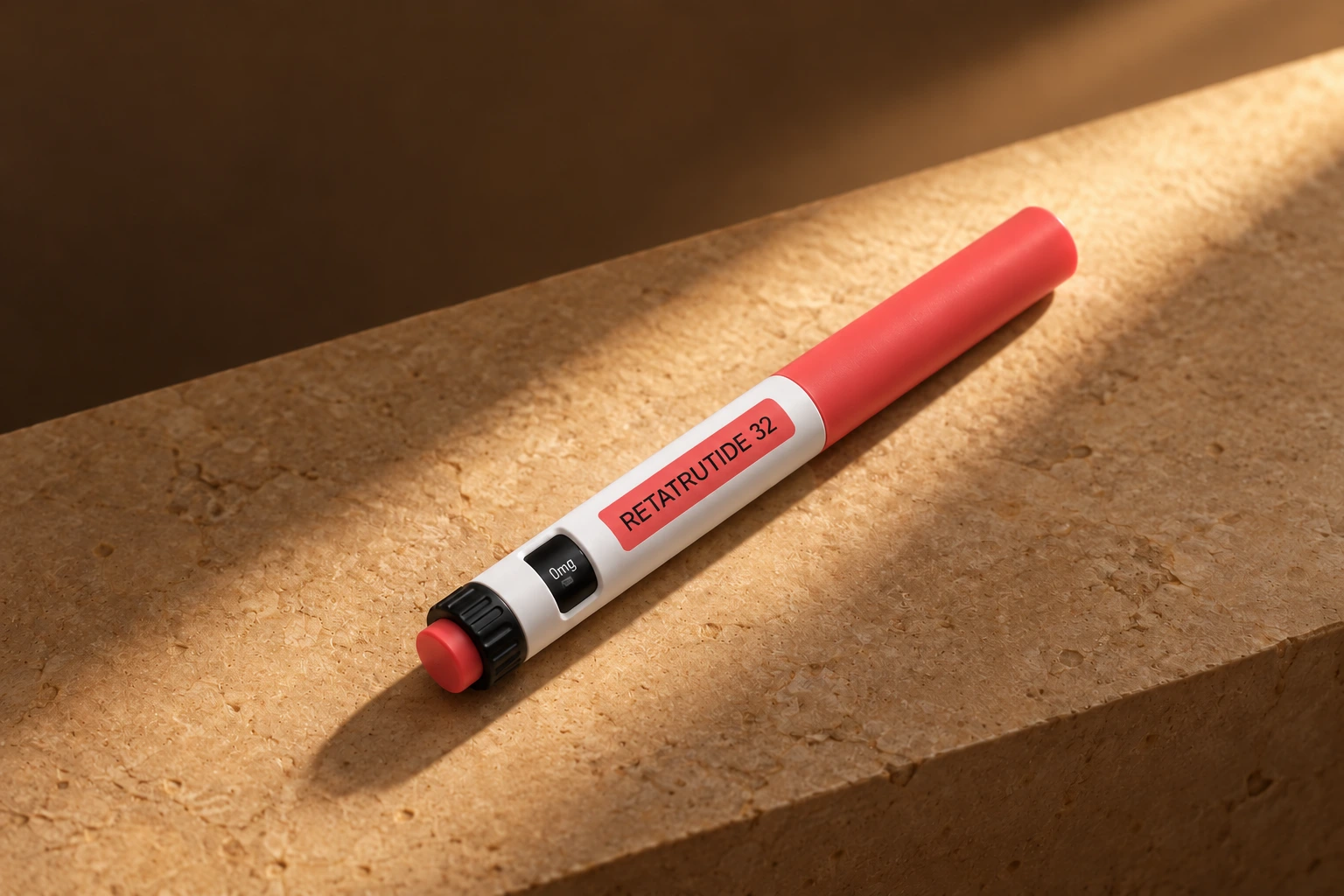
Albumin, creatinine and eGFR can appear together in a discussion of retatrutide, yet they are not three names for the same result. If you are researching retatrutide in Bali, the first useful step is to identify the sample, calculation and clinical question behind each term.
The retatrutide catalogue page is the place to check the listed presentation. Personal kidney results belong in a clinical review. Keeping those two tasks distinct makes both the research and the shopping information easier to use.
Identify the sample before the number
A blood test and a urine test provide different information. Estimated filtration can be calculated using blood markers. UACR is a ratio in urine. A reference to creatinine can therefore occur in different contexts, which is one reason a cropped laboratory result can be confusing.
| Term | Context to identify | What it does not establish alone |
|---|---|---|
| Blood creatinine | Blood measurement used in some estimates | A complete kidney diagnosis |
| eGFR | Calculated estimate of filtration | The cause of a personal change |
| UACR | Urine albumin-to-creatinine ratio | A substitute for filtration assessment |
| Measured GFR | A specified measurement procedure | Equivalence with every estimate |
If an overseas report uses a different unit or layout from a Bali laboratory, keep both complete documents. Ask the clinician to compare them rather than converting labels by eye. The laboratory name and collection date can be as useful as the value itself.
Match a retatrutide claim to its endpoint
The retatrutide kidney-marker paper analyses two phase 2 trial datasets. It considers estimated filtration and albuminuria in specified metabolic populations. This evidence should be described at that level, without silently becoming a claim about preventing kidney failure.
When a headline says “kidney improvement,” ask what improvement means in that source. Was it a blood estimate, a urine marker, a clinical event or a participant's report? The answer determines what can reasonably be inferred.
Also ask whether the article describes a group average or an individual finding. A group result cannot explain your own change without the surrounding history. A measurement taken after a product was started does not, by timing alone, prove what caused it.
Separate the next research question from its answer
The TRANSCEND-CKD design publication describes an investigation using measured filtration and additional kidney assessments. The baseline characteristics show the starting population. They are not the study's treatment results.
This distinction is easy to lose when research announcements circulate in short form. A design paper, registry entry and outcome paper may share a trial name. Save the document type with the link so they do not merge into one claim in your notes.
You can remain interested in a research programme while leaving unanswered questions open. A precise question is more useful than a confident prediction, particularly when someone is already receiving care for kidney disease or diabetes.
Bring a question that a clinician can answer
For a Bali appointment, prepare the sequence of laboratory reports, your current medicines and the exact concern. Ask whether the reports use comparable methods, whether a result needs confirmation and what it means for the existing care plan.
If your regular clinician is elsewhere, decide how follow-up information will reach them. Someone staying in Seminyak for a few weeks and someone living in Indonesia long term may need different arrangements, even when they are reading the same paper. This is about continuity, not a claim that a specific service is available locally.
Do not use the article as a reason to discontinue prescribed treatment. A product catalogue cannot decide which kidney or diabetes medicines should be changed. Those decisions require the patient's history and clinical responsibility.
A clear catalogue enquiry
The full catalogue can help you compare listed ingredients and formats. For a specific item, ask which presentation is being offered and what documents relate to it. Avoid assuming that every product sharing a molecule name has been studied in the same way.
Keep product documentation separate from personal test results. A certificate about a batch cannot interpret a person's kidney function, and a reassuring personal result cannot prove the contents of a pen. Naming the document you need is a practical way to prevent those conversations from drifting together.
FAQ
Why does creatinine appear in more than one test name?
It can occur in different sample and calculation contexts. Check whether the report concerns blood, urine or an estimated filtration equation.
Does a retatrutide paper prove a catalogue item treats kidney disease?
No. The study population, preparation and endpoint must remain attached to the finding.
Should I bring only the most recent result?
Bring relevant earlier reports as well. A clinician can decide which comparisons are meaningful and whether further assessment is needed.
Sources & further reading
Educational information. For personal treatment decisions and instructions, consult a qualified clinician or pharmacist with the details of your exact product.