Niacin metabolite 4PY and heart risk: what the cohort actually measured
A 4PY association in cardiovascular cohorts and a mouse vessel experiment answer different questions from a trial of an NAD+ product.
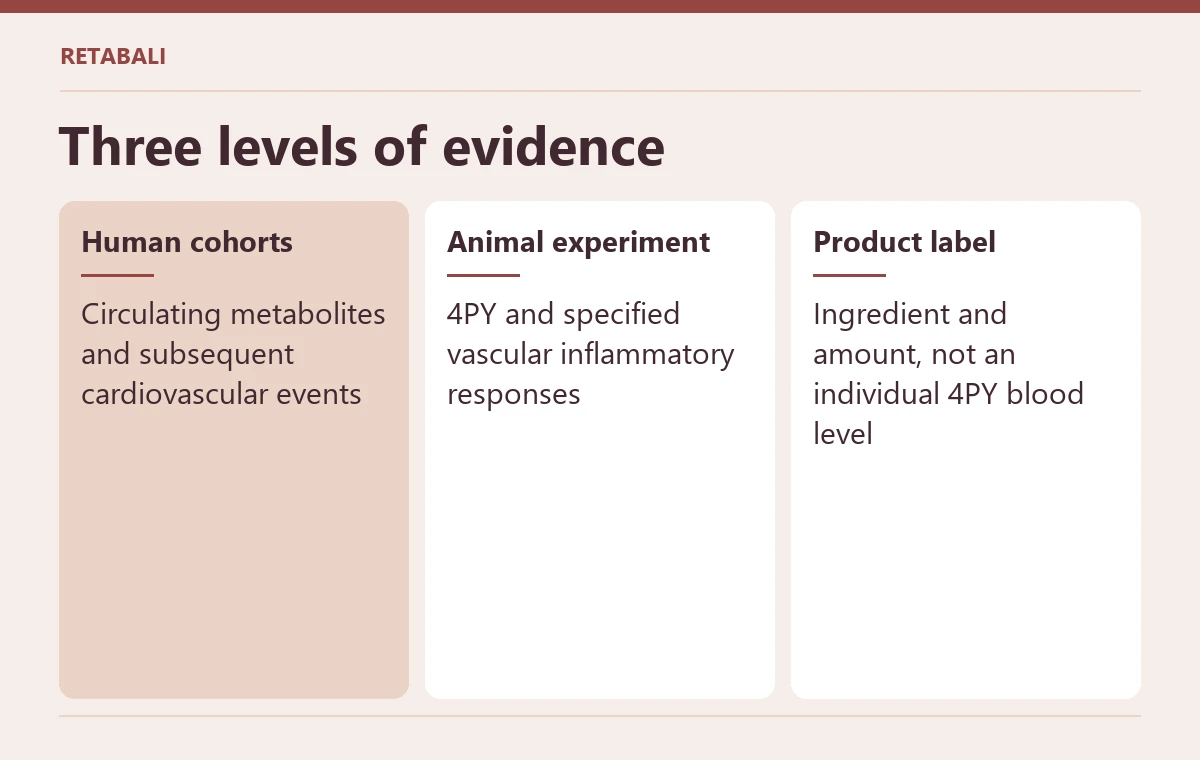
A cardiovascular study associated higher blood levels of two terminal niacin metabolites, 2PY and 4PY, with more major cardiovascular events during follow-up. The researchers measured metabolites in participants and also performed separate experiments. They did not randomise the participants to an NAD+ product or establish a personal intake limit from a blood concentration.
Start with the specimen rather than the supplement
The research team first investigated fasting plasma from a discovery cohort of stable cardiac patients, then examined the association in independent US and European cohorts. In both validation populations, higher levels of the metabolites were associated with a higher risk of major cardiovascular events over three years. Repeating an association in different cohorts strengthens the evidence that the observation deserves attention. It does not reveal how much niacin each participant obtained from a particular food or supplement. Primary study of niacin metabolites and cardiovascular risk
Niacin is a dietary vitamin. Nicotinic acid, nicotinamide and related compounds participate in a wider metabolic network, but the name of the vitamin is not interchangeable with the name of a measured breakdown product. A label expressed in milligrams of an ingredient and a blood concentration of 4PY are distinct measurements. The paper provides no rule for converting one to the other for a shopper in Bali. NIH fact sheet on niacin
Why the mouse experiment is a separate line of evidence
The authors also investigated a possible inflammatory mechanism. In mice, administration of 4PY induced specified changes involving a vascular adhesion molecule and leukocyte adhesion to the vascular lining. Its structural isomer 2PY did not produce the same result in that experiment. By contrast, both metabolites were associated with subsequent events in the human cohorts. Remembering which observation concerned which molecule prevents the mouse mechanism from being assigned indiscriminately to every human association.
A mechanism can make an association biologically plausible. That is different from measuring the clinical effect of a defined vitamin product in a randomised comparison. Factors that influence metabolite concentrations can also relate to health and future risk. Statistical adjustment helps investigators examine such possibilities without converting a measured concentration into an assigned treatment.
What to bring to a Bali consultation
If an article about 4PY raises a question about a product you use, bring the actual ingredient panel, amount per serving, route and reason for using it. A packet of food, a prescribed medicine, an oral vitamin and a catalogue pen are not interchangeable exposures. Do not use the cohort estimates to change prescribed treatment or to remove ordinary dietary niacin. Ask the clinician which question is relevant to you: vitamin intake, a medicine's known effects or cardiovascular risk assessed from your own history.
