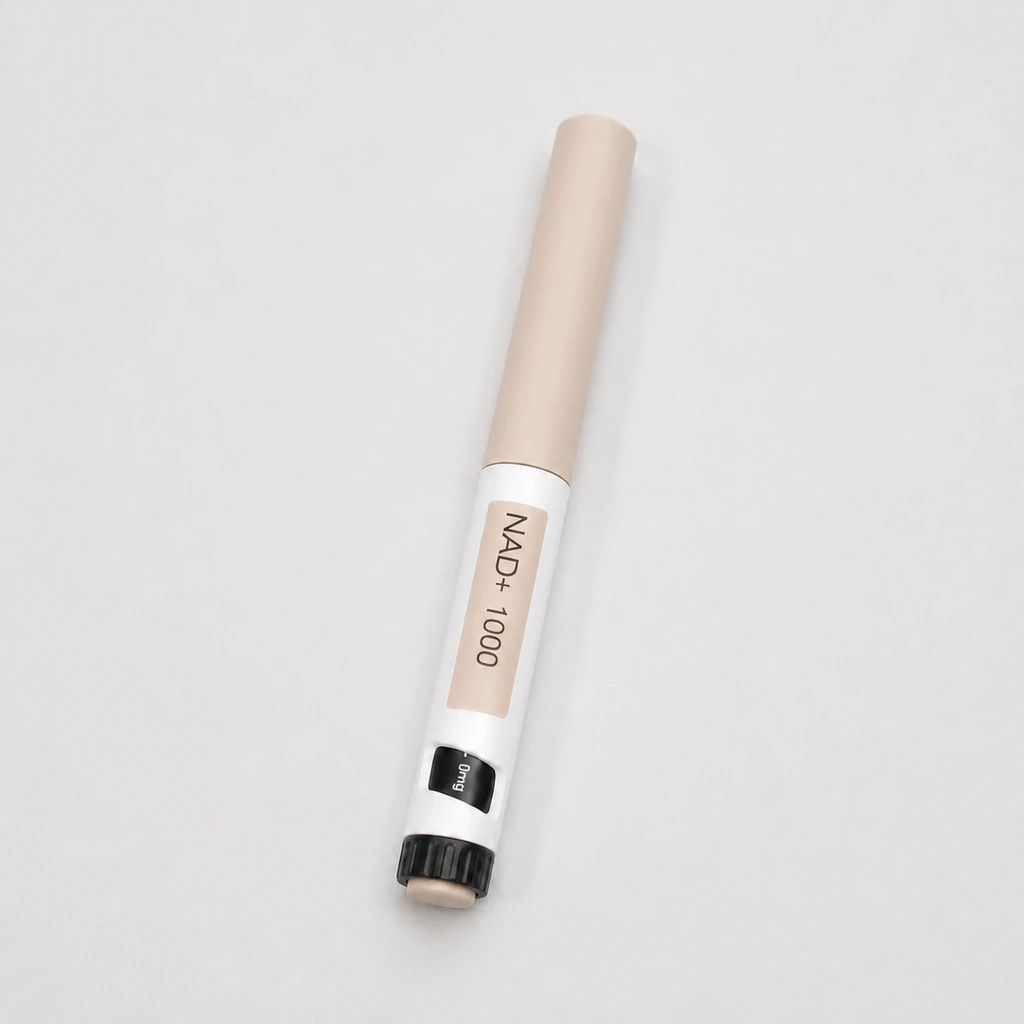
An NADH supplement is not the same finished product as an NAD+ pen. For a useful comparison in Bali, check the exact ingredient, route, amount per purchase unit and any additional ingredients. The catalogue offers an NAD+ pen labelled 1,000 mg total contents; it does not offer NADH tablets or capsules.
Put complete product labels beside each other
The names look close enough that a search for one can bring up the other. The NIH PubChem entry identifies NADH as the reduced form of the NAD coenzyme, while NAD+ is its oxidized form. That short chemical distinction helps prevent a naming error; it does not choose a treatment or prove that one retail product gives more energy.
The NAD+ pen listing supplies a specific catalogue reference. Compare that with a complete NADH label, not a general advertisement saying “NAD support”.
| Label detail | NAD+ pen in this catalogue | An oral NADH offer |
|---|---|---|
| Named ingredient | NAD+ | Confirm that it is actually NADH |
| Purchase unit | One pen | Check tablets or capsules per pack |
| Amount | 1,000 mg total labelled contents | Check amount per unit and serving separately |
| Other ingredients | Request the full product specification | Read the entire ingredient list |
| Evidence question | Was the exact preparation and route studied? | Was NADH alone or a combination studied? |
If an oral product contains NADH plus other active ingredients, write those down. Its brand name may emphasize only one component. That matters both for interpreting research and for discussing the complete product with a clinician.
A whole pen and one serving are different denominators
A large number on the pen cannot be directly compared with the amount in one tablet. One is a total-container figure; the other may be a per-unit or per-serving figure. Multiplying by the pack count can explain the labelled purchase contents, but it does not establish equivalent treatment.
Also check whether the serving includes several tablets. A product title can show an amount without making the denominator obvious. Use the detailed label rather than the largest number on the front.
There is no justified conversion here from milligrams of oral NADH to milligrams in an NAD+ pen. The chemical form, route and finished formulation differ. A value comparison that ignores those differences creates a clinical equivalence the arithmetic cannot support.
Read the human evidence without dropping ingredients
An eight-week randomized study in 73 people with chronic fatigue syndrome examined an oral combination of coenzyme Q10 and NADH. It was not an investigation of NADH alone in healthy holidaymakers, and it did not test an NAD+ pen.
That distinction is practical. If a retailer cites the combination study for a single-ingredient product, part of the studied intervention has disappeared. If the customer does not have the studied condition, the population has changed as well.
A small NAD+ infusion study examined changes in plasma and urine metabolites during intravenous administration. It answers another research question, not whether a pen is a better purchase than oral NADH. Measuring metabolites is different from establishing better daily function or a reliable improvement in fatigue.
Choose the right question before comparing offers
“Which product has the ingredient on this label?” is an identification task. “Which intervention helps my ongoing fatigue?” is a clinical question. “What is available for an order in Bali?” is a commercial question. Keeping them separate makes the comparison useful instead of allowing one convenient answer to stand in for all three.
If you already have a proposed product, bring its full label and your current medicine list to a qualified clinician. Include all components of an oral combination. Do not introduce a pen simply because a supplement result was disappointing, or infer that a different route must solve the problem.
Our NAD+, NR and NMN identity guide addresses precursor names. NADH is a different naming issue and should remain clearly identified in the present comparison.
Confirm the item you mean in Bali
For a catalogue enquiry, specify the NAD+ 1,000 mg pen and quantity, together with the actual Bali handover location. Ask for the exact product documents and applicable storage information. A reply about an IV service or oral supplement does not answer that request.
Keep the documented product details with the confirmation. If you later compare a second supplier, use the same fields rather than matching only “NAD” in the heading. This prevents a route or ingredient change from being mistaken for a simple brand switch.
Questions buyers ask
Does NADH mean the pen contains extra hydrogen?
No. NADH identifies a particular chemical form. It is not a feature added to this NAD+ pen or an interchangeable catalogue variant.
Is the product with more milligrams better?
The figures describe labelled amounts, not equivalent effects across forms and routes. Compare like purchase units for bookkeeping, while keeping clinical conclusions separate.
Does the oral combination trial prove an NAD+ pen treats fatigue?
No. The ingredients, route and tested intervention differ. Persistent fatigue deserves an assessment rather than a product choice based on a similar name.
Sources & further reading
Educational information. For personal treatment decisions and instructions, consult a qualified clinician or pharmacist with the details of your exact product.