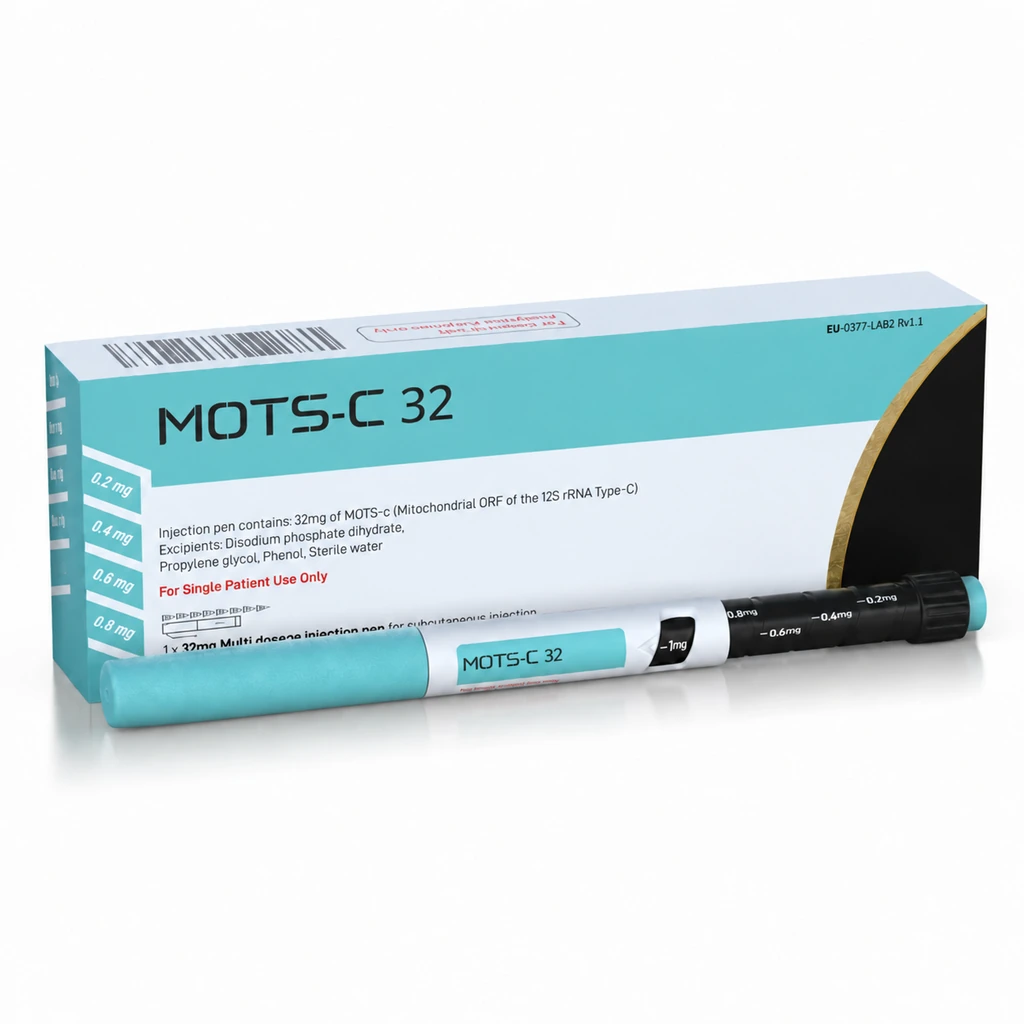
MOTS-C and NAD+ are not interchangeable energy products. MOTS-C is a mitochondrial-encoded peptide involved in cellular signalling; NAD+ is a coenzyme involved in cellular reactions, including electron transfer. In Bali, both may appear in longevity conversations, but that shared category does not mean they have the same mechanism, evidence or expected effect when sold in a pen.
MOTS-C vs NAD+: what is actually different?
| Question | MOTS-C | NAD+ |
|---|---|---|
| What is it? | A peptide associated with mitochondrial biology | Nicotinamide adenine dinucleotide in its oxidized form |
| Broad biological role | Signalling and metabolic regulation under investigation | A cofactor used in cellular redox reactions |
| Research trap | Equating naturally occurring exercise responses with injected-product effects | Equating a necessary cellular molecule with proven benefit from adding it |
| Listed pen contents | 32 mg | 1,000 mg |
The difference in total milligrams does not show that one is stronger. Different molecules have different roles; a mass comparison cannot answer whether either addresses a person's fatigue or training concern.
Why NAD+ is not a peptide
The NIH PubChem entry for NAD+ identifies it as a nucleotide coenzyme. It is not a chain of amino acids like a peptide. Shops may place it next to peptide products for catalogue convenience, but that does not change its chemistry.
The distinction also prevents an easy reasoning error: being essential inside cells is not proof that a particular administered product increases energy or improves wellbeing. The clinical question requires evidence about the actual intervention, not only a description of the molecule's normal role.
What the MOTS-C exercise study does and does not show
A Nature Communications study measured exercise-associated changes in naturally occurring MOTS-c in people and included separate preclinical intervention experiments. Observing a human exercise response is different from testing the outcome of giving people a retail MOTS-C pen.
When reading an article about this research, identify which part concerns people, which part involves an administered substance and what was measured. Combining those sections into “injections improve human performance” skips a step the research does not establish. This does not make the findings uninteresting; it defines the question still needing an appropriate clinical study.
Feeling energetic is not the same as a laboratory endpoint
“Energy” may refer to cellular chemistry, a blood measurement, exercise output or how tired someone feels. A change in one cannot automatically be read as a change in another. A trial that measures metabolites is not the same as a trial demonstrating better daily functioning.
For example, a small NAD+ infusion study investigated plasma and urine metabolite changes during an intravenous infusion. It was not a direct MOTS-C comparison or evidence that a pen produces the same result. The delivery route and measured question both matter.
A useful comparison for buyers in Bali
Write down your actual question before opening product pages. “I want to understand a mitochondrial peptide” is different from “I am persistently exhausted” or “I want to compare two existing product formats”. Persistent unexplained fatigue belongs in a clinical assessment rather than being matched to an energy category by name.
For the product comparison, the MOTS-C page and NAD+ page identify the offered formats and total contents. Add two columns to your notes: the formulation used in the research and the outcome the study measured. If the route or outcome differs, keep that mismatch visible instead of writing a single benefit score.
If you are staying in Canggu or moving between Bali accommodation, product-specific storage and continuity are practical questions to settle separately. Local availability does not establish that one molecule fits your situation. Our MOTS-C and caffeine article also explains why a stimulant-style feeling should not be treated as a universal test of a peptide's action.
Questions buyers ask
Can NAD+ replace MOTS-C, or the other way round?
Their biological roles do not support that shortcut. The sources here do not establish equivalent products, a conversion or a direct clinical winner. Start with the relevant evidence and exact product rather than swapping names within a longevity category.
Does a combined bundle prove that they work better together?
No. A bundle groups products commercially. Establishing an additional benefit from a combination requires evidence about that combination, including the relevant formulation and outcomes. Separate biological rationales are not a substitute.
Sources & further reading
Educational information. For personal treatment decisions and instructions, consult a qualified clinician or pharmacist with the details of your exact product.