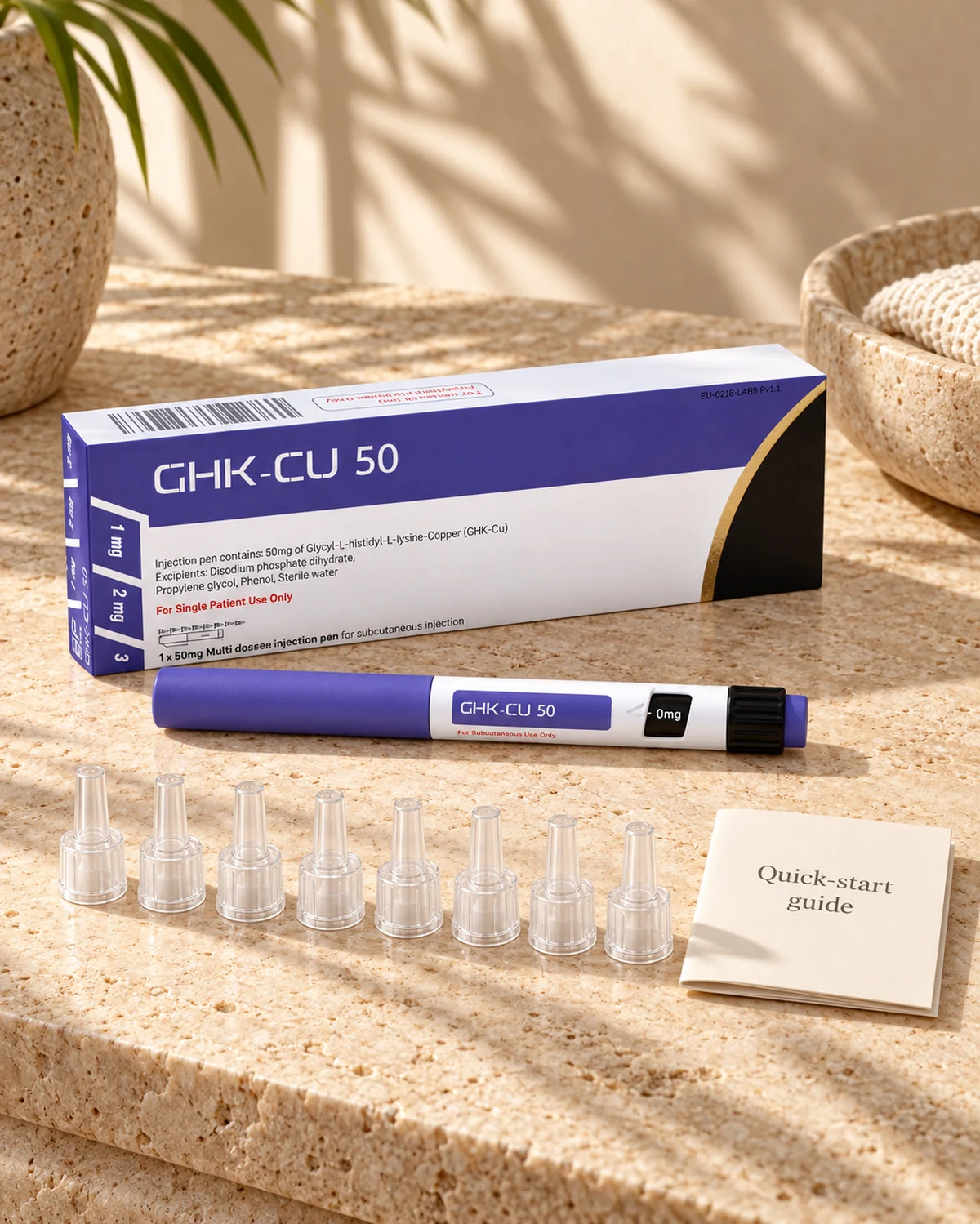
The first difference between GHK-Cu and salicylic acid may be the format you are actually looking at. A pen, a cleanser and a leave-on serum are not equivalent products. For readers in Bali, identifying that difference is more useful than asking which ingredient is universally “better for skin.”
Our GHK-Cu product page describes a pen presentation. Salicylic acid appears here to clarify a topical skincare comparison. The article is not a recommendation to combine the two or to transfer instructions between them.
Define the outcome you mean
Clogged pores, active acne, uneven texture and appearance after a procedure are different questions. A broad label such as rejuvenation can conceal those differences. Write down the specific concern before looking at evidence or choosing a product.
| Comparison step | A useful answer | An incomplete answer |
|---|---|---|
| Identify the concern | A named problem to assess | Better skin |
| Identify the format | Complete cosmetic or pen presentation | Same ingredient name |
| Identify the evidence | Route, population and endpoint | A study exists |
| Identify the next step | Product clarification or clinical review | Copy someone else's routine |
This structure helps distinguish a question the shop can answer from one that requires assessment of the skin itself.
Where salicylic acid fits
The American Academy of Dermatology acne guideline conditionally recommends topical salicylic acid among treatment options. The recommendation has a defined clinical context. It does not establish that every formulation is interchangeable or that an acid addresses every kind of visible skin change.
Look at the complete product label and its instructions. A wash-off item and a leave-on item should not share an improvised schedule simply because the ingredient name matches. A procedure performed by a professional is another context again.
If acne is persistent, painful or leaving scars, seek a dermatological assessment rather than treating the search results as a diagnosis. The purpose of a comparison is to sharpen the question, not to replace that assessment.
Keep copper-peptide research specific
The GHK-Cu post-laser study investigated topical care after a particular resurfacing procedure. It does not establish a pen as an acne treatment and does not supply a head-to-head comparison with salicylic acid.
A good evidence note includes the product route and what was measured. Skin satisfaction, redness, texture and acne lesions are not the same endpoint. Changing the endpoint in a marketing summary can make a paper seem to answer a question it never investigated.
Also distinguish a molecule from a finished preparation. Evidence about one formulation does not authenticate another item or establish its instructions. That remains true even when a scientific name appears on both labels.
Applying the comparison to a Bali enquiry
For a clinical discussion, bring your existing routine and recent procedure history. Products bought abroad may use different marketing names, so complete labels are more useful than nicknames. Describe the concern in ordinary language and ask what information the professional needs next.
If you are visiting Bali, clarify follow-up before starting a treatment that needs review. Confirm actual services with the provider; this article does not claim a specific procedure is offered in Seminyak, Canggu or another location.
For a product enquiry, identify the exact listing. Ask about the ingredient, presentation and available documents. Do not ask a pen label to answer a cosmetic compatibility question or a photograph to establish clinical suitability.
Avoid an amount-versus-percentage mistake
A total quantity on a pen and a percentage on a cosmetic are different kinds of label information. Neither can be substituted for the other's instructions. The catalogue can help identify which presentation you are viewing, but it does not convert the formats into equivalents.
This guide contains no recipe for mixing products and no recommendation to apply a pen preparation topically. If the intended route is unclear, resolve that uncertainty before making a decision based on a skincare comparison.
FAQ
Does more skin research mean one ingredient is better for me?
The relevant question is whether the evidence matches your concern and the actual formulation, not simply how many papers mention the molecule.
Is a topical copper-peptide result evidence for a pen?
It cannot automatically be transferred to a different route or preparation.
What is the most useful first question?
Ask what the product actually is and which specific concern you want addressed. Those details make the rest of the comparison meaningful.
Sources & further reading
Educational information. For personal treatment decisions and instructions, consult a qualified clinician or pharmacist with the details of your exact product.