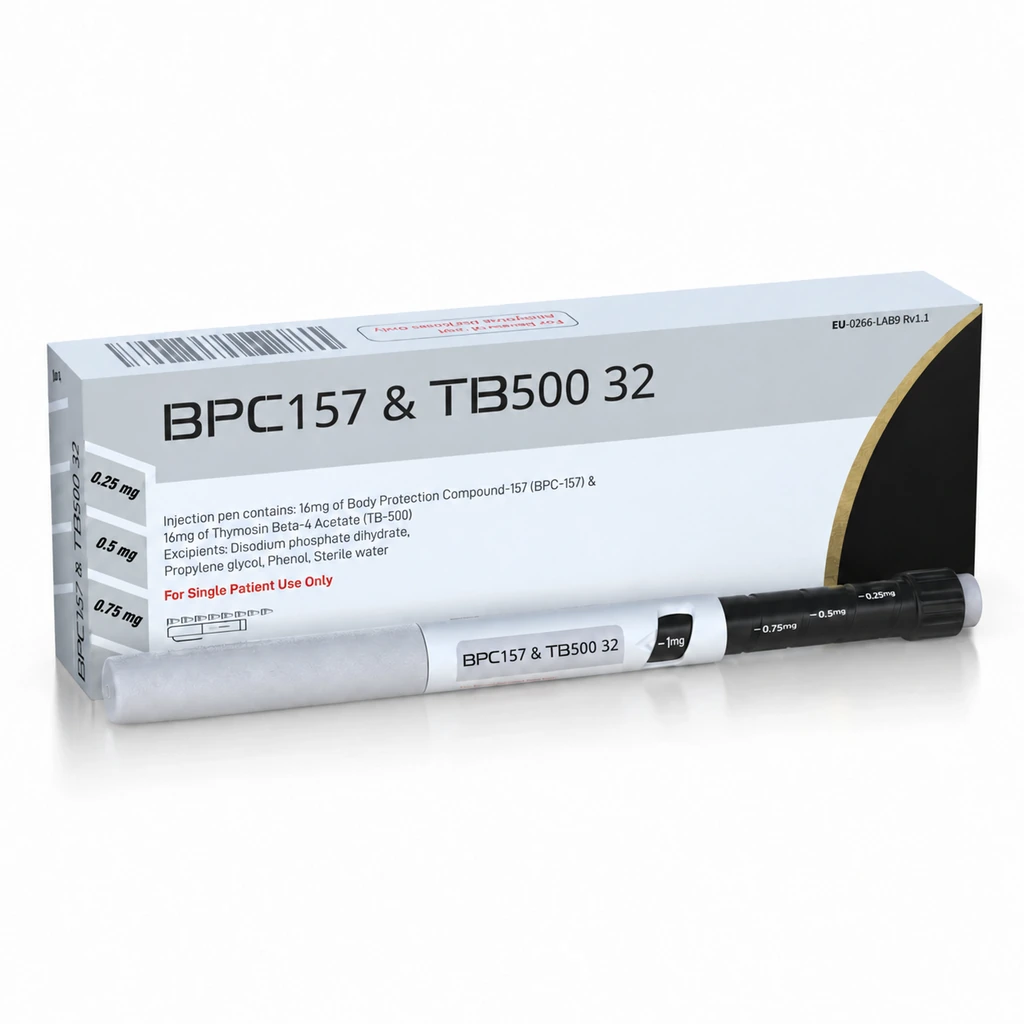
BPC-157 and TB-500 are different peptide names, not two strengths of the same ingredient. Their research cannot be combined into a promise that a blended pen repairs an injury. For readers in Bali comparing recovery products, the important distinction is between a laboratory finding, a clinical trial of a particular formulation and the exact product being offered.
BPC-157 vs TB-500: separate the research questions
| Question | BPC-157 | TB-500 / thymosin-related research |
|---|---|---|
| What attracts attention? | Tissue-repair and tendon-cell experiments | Thymosin-beta-4-related repair biology |
| Example discussed here | Tendon explants and cultured fibroblasts | A particular thymosin-beta-4 eye-drop trial |
| What must be checked? | Experimental model and measured outcome | Exact molecule, formulation and route |
| What the evidence does not establish | A retail pen's effect on a human injury | Equivalence of an injectable product to the studied eye drops |
“Recovery” is a broad catalogue category. It does not identify a diagnosis, a validated treatment or a predictable return-to-training date. A useful comparison starts by asking what tissue and what outcome a source actually investigated.
What the BPC-157 tendon study measured
The 2011 tendon study examined rat Achilles-tendon explants and cultured tendon fibroblasts. Researchers investigated outgrowth, cell migration and survival under experimental conditions. Those are specific biological observations, not a trial demonstrating how quickly people return to running or surfing.
The distinction helps you read claims without dismissing the research itself. A cell moving in an experimental model can provide a reason for further investigation. It does not answer whether a particular pen improves pain, function or healing in a person, nor does it establish the appropriate clinical approach to an injury.
Why the name TB-500 needs closer attention
Thymosin beta 4 is a defined peptide, while commercial use of the name TB-500 is not sufficiently precise to identify the substance from the name alone. Do not assume that every listing or study using related wording describes the same sequence or preparation. Product-specific documentation matters here.
A phase II dry-eye study investigated a thymosin-beta-4 ophthalmic solution. Its route, target tissue and study population are different from an injectable recovery product. Evidence about eye symptoms cannot be relabelled as a study of tendon recovery simply because a related peptide name appears in both descriptions.
The FDA's assessment of certain peptide ingredients also highlights limits in available safety information and product-quality questions. This is a US regulatory source, not proof of a product's authorization in Indonesia or a finding about an individual seller's batch.
What the 16 + 16 mg blend means
The BPC-157 + TB-500 product page lists 16 mg of each named ingredient, or 32 mg total. That is a contents statement. It does not represent a studied clinical ratio, a recommended dose or evidence that the ingredients improve each other's effects.
Our blend and recovery-bundle comparison answers a different question: whether ingredients share one product or several items are grouped together. Neither arrangement turns separate ingredient research into a trial of the complete combination.
A practical way to compare recovery information in Bali
If pain or loss of function is limiting a Canggu gym session or time in the water, start by identifying the problem with a qualified clinician. The useful questions are about the diagnosis, relevant treatment options and meaningful measures of recovery. A product category cannot answer those questions.
For the commercial comparison, record the exact ingredient names, stated contents and the documentation available for the specific item. Then place the cited research alongside it: same molecule, same route, same condition and same outcome? Any missing match should remain visible. Use the peptide catalogue to identify products, not to infer clinical suitability from neighbouring cards.
Questions buyers ask
Is one ingredient definitely better for tendons?
The sources discussed here do not provide a direct human comparison establishing a winner. Differences in mechanisms or experimental models cannot substitute for that comparison.
Does buying the blend solve the uncertainty?
No. It changes the product format, not the evidence. The exact blend would need appropriate evidence of its own; two interesting research histories do not automatically produce a validated combined treatment.
Sources & further reading
- The promoting effect of pentadecapeptide BPC 157 on tendon healing involves tendon outgrowth, cell survival, and cell migration
- Thymosin beta 4 ophthalmic solution for dry eye: a randomized, placebo-controlled Phase II trial
- Certain bulk drug substances for use in compounding that may present significant safety risks
Educational information. For personal treatment decisions and instructions, consult a qualified clinician or pharmacist with the details of your exact product.